
Welcome to our blog, where we provide the insights and guidance you need to navigate your financial journey with confidence! At Infinite Heights, we focus on making all things money approachable and empowering. As a female-focused financial planning firm, we’re passionate about guiding women (and the men who love them) toward mastering their finances with confidence and clarity. Think of us as your personal financial guides, here to help you navigate the world of money, make informed decisions, and help you build a life that you love!


July Market Recap
If there was one lesson July reinforced, it's that even strong markets experience periods of uncertainty.
After months of steady gains, investors were reminded that volatility is a normal part of investing. Questions surrounding artificial intelligence spending, rising Treasury yields, renewed tensions in the Middle East, and uncertainty around future Federal Reserve policy all contributed to a month that felt more unsettled than those preceding it.

Making the Most of a 529 Plan: Education Savings Beyond College
As another school year begins, many families naturally start thinking about education. School supplies, tuition payments, and future college costs often take center stage. But behind those seasonal expenses is a much bigger question: How do you prepare financially for opportunities that may still be years—or even decades—away?

Small Business Taxes: How Everyday Decisions Shape Your Tax Bill
Most people do not start a business because they are excited about accounting.
You start because you have an idea, a skill, a product, or a service you believe in. You want to build something meaningful, create more flexibility, or turn a side project into a real source of income. Reconciling bank accounts and saving receipts for every business lunch probably did not make the original vision board.

Retirement Planning 101: When Retirement Starts Feeling Closer Than It Used To
There is a moment when retirement stops feeling like a distant concept and starts feeling real.
Maybe it's when you realize you're closer to 60 than 40. Maybe it's when a colleague announces their retirement. Maybe it's when you receive your Social Security statement and, for the first time, actually look at the numbers.

Mid-Year Outlook 2026: Key Investor Lessons for the Second Half of the Year
Over the past six months, investors have watched geopolitical conflict, rising energy prices, inflation concerns, ongoing conversations about interest rates, and continued excitement surrounding artificial intelligence. At times, it may have felt like uncertainty was everywhere.

What Happens When Life Changes Faster Than Your Financial Plan?
Most financial plans aren't disrupted by the stock market.
They're disrupted by life.
A new job opportunity. An unexpected inheritance. A growing family. A business sale. A health event. A planned retirement that suddenly arrives sooner than expected.

The Mid-Year Reset: Why July Is One of the Most Important Planning Months of the Year
January gets all the attention.
It's the season of fresh starts, new goals, and ambitious resolutions. We tell ourselves this will be the year we save more, get organized, pay off debt, invest consistently, or finally tackle the financial projects we've been putting off.

"I Do" to Your Financial Future: Starting Your Financial Life Together
The champagne has settled. The thank-you notes are almost done. And somewhere between returning duplicate blenders and updating your last name on every account you've ever had, a quieter question starts to surface: What does our financial life actually look like now?

May Market Recap
If there's one thing May reminded us, it's that markets rarely wait for the all-clear.
This was another month where the headlines and the market seemed to tell two very different stories.
Inflation remained stubbornly higher than many economists expected. Interest rates climbed to levels we haven't seen in years. There was a leadership transition at the Federal Reserve. Geopolitical tensions remained unresolved. Yet despite all of that, the stock market continued moving higher.

Saving For A Home in Oregon Can Also Lower Your State Tax Bill – Here's How
There's a particular kind of excitement that comes with deciding you're ready to buy. The late-night Zillow scrolling. The mental math about down payments. The slow realization that saving for a home isn’t just about putting money aside — it's about having a plan, and for Oregon homebuyers, it’s about having the right account.

Summer May Be Quieter, But Your Financial Life Keeps Moving
There's a collective exhale that happens every June. School's out, the calendar clears a little, inboxes slow down, and somewhere between the cookouts and the beach trips, most people quietly stop thinking about money. Goals set in January get pushed to September. Contributions feel optional. Reviews get rescheduled.

Your Home Is Doing More Work Than You Think: A Housing Market Update
For most people, home isn't just where you live — it's your biggest financial asset, your largest monthly bill, and probably your biggest source of debt all rolled into one. And while everyone's been watching stock market swings and global headlines lately, here's something worth paying attention to: home prices are still near all-time highs, and that quietly shapes a lot about your financial picture.

What Separates Women Who Grow Wealth From Those Who Don't
I have sat across from hundreds of accomplished women over the years — founders, executives, investors, women who have built extraordinary things. And time and again, I have noticed that what separates those who grow lasting wealth from those who plateau has very little to do with income. It has everything to do with how they think, and what they decide to do next.

April Market Recap
April was a month that tested a lot of us — and then quietly rewarded those who stayed the course.
I want to be honest with you: the backdrop wasn't easy. Geopolitical tension in the Middle East. Oil prices swinging by nearly $30 a barrel in a single month. Jerome Powell stepping down as Fed Chair after seven years. A Fed committee more divided than it's been since 1992. Any one of those things would have been enough to rattle markets. Together, they made for a lot of anxious headlines.

Financial Literacy For the Established Entrepreneur: Building Wealth with Intention
There comes a point in every entrepreneur’s journey where growth alone is no longer the goal—alignment is. You’ve built something meaningful. Revenue is steady, your business has momentum, and your personal wealth is no longer an abstract concept. And yet, with that success comes a more complex question: Am I making the most of what I’ve built?

Q1 2026 Market Recap: A Reminder of What Matters Most
The first quarter of 2026 served as a reminder of why preparation matters when it comes to financial planning and investing.
After a strong 2025, markets entered the year facing a mix of geopolitical tension, rising oil prices, and renewed uncertainty. The conflict in Iran, which escalated at the end of February, quickly became the dominant story—driving oil prices higher and leading to the first meaningful pullback of the year.


The Financial Literacy Fundamentals Every Business Owner & Entrepreneur Needs to Know
April is Financial Literacy Month — the perfect time to take stock of where you stand and build a stronger financial foundation.
Whether you're running a growing business, navigating the path to retirement, or building something from the ground up, financial literacy isn't a nice-to-have. It's the foundation everything else rests on.

Celebrating Women’s History Month
This Women’s History Month, let’s not only reflect on the past but also take action toward a more equitable future. Support women-owned businesses, amplify women’s voices, and encourage financial literacy among women of all ages.
Here’s to strong women—past, present, and future. May we celebrate them, learn from them, and continue their legacy of resilience and success.
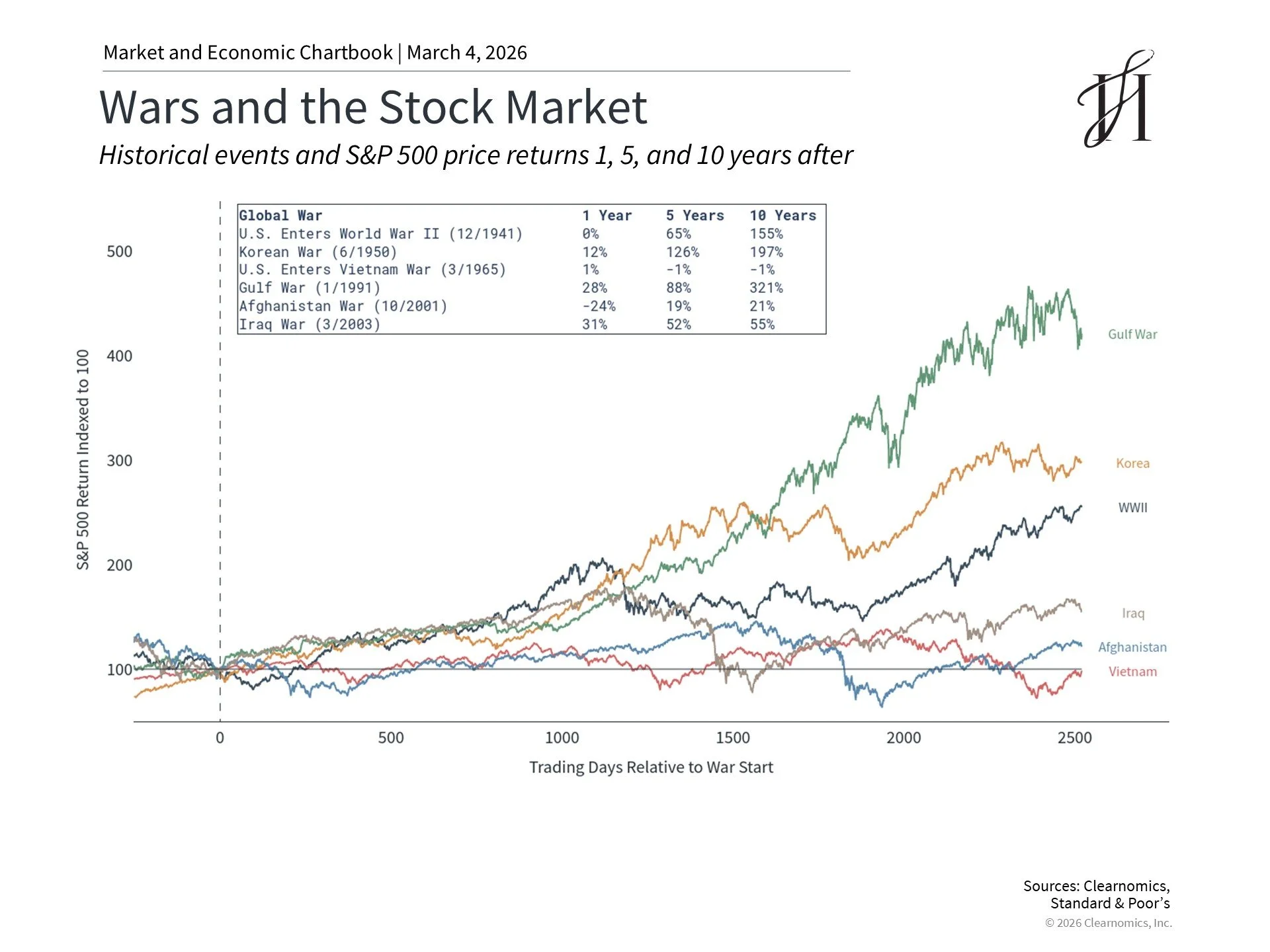
Special Update: Iran and Long-Term Investing
Global events can create uncertainty and unsettling headlines, but history shows that markets have navigated wars, conflicts, and geopolitical tension before. In this update, we share perspective on the recent U.S. and Israeli strikes on Iran, what it could mean for energy markets, and why long term investors are best served by staying focused on their financial plan.