
What Separates Women Who Grow Wealth From Those Who Don't
I have sat across from hundreds of accomplished women over the years — founders, executives, investors, women who have built extraordinary things. And time and again, I have noticed that what separates those who grow lasting wealth from those who plateau has very little to do with income. It has everything to do with how they think, and what they decide to do next.
This isn't a conversation about budgeting tips or savings accounts. If you're reading this, you have already moved well past that. This is a conversation about the subtler, more consequential decisions that compound quietly over time — the habits of mind and the strategic choices that distinguish women who are accumulating wealth from women who are genuinely building it.
The distinction matters. And in my experience, it comes down to a handful of identifiable patterns.
They stopped treating wealth as a destination — and started treating it as a practice
The First Distinction:
Many high-achieving women reach a certain threshold and exhale. They've built the business, secured the income, paid off the debt. There's a natural and understandable impulse to arrive somewhere and rest. But wealth — real, multigenerational, lasting wealth — doesn't function like a finish line. It functions like a practice.
The women I have watched grow their wealth most intentionally are the ones who check in on their financial picture the way they check in on their business metrics. Not obsessively, but consistently. They have a relationship with their numbers. They understand their net worth not as an abstract figure but as a living, moving measure of how well their decisions are working.
This means they are never surprised by their money. They are in conversation with it.
“Wealth is not built in moments of bold action alone. It is built in the quiet
discipline of returning - again and again - to your strategy with clear eyes and a willingness to evolve.”
They have learned to hold ambition and protection at the same time
The Second Distinction:
One of the most common patterns I see among high-achieving women is a tendency toward one of two extremes. Either they are so focused on growth that protection goes unconsidered — no estate plan, underinsured, no clear succession strategy — or they have become so protective of what they've built that they aren't allowing it to work hard enough for them.
The women who grow wealth understand that ambition and protection aren't in opposition. They are both required. The goal is a financial architecture that allows you to pursue meaningful growth while ensuring that what you've already built is shielded from avoidable risk. These aren't competing priorities. They are the two pillars of a strategy that endures.
This is, honestly, where intentional planning becomes irreplaceable. Because holding both — growing and protecting simultaneously — requires a level of strategic coordination that is difficult to execute alone.
The patterns that show up, again and again
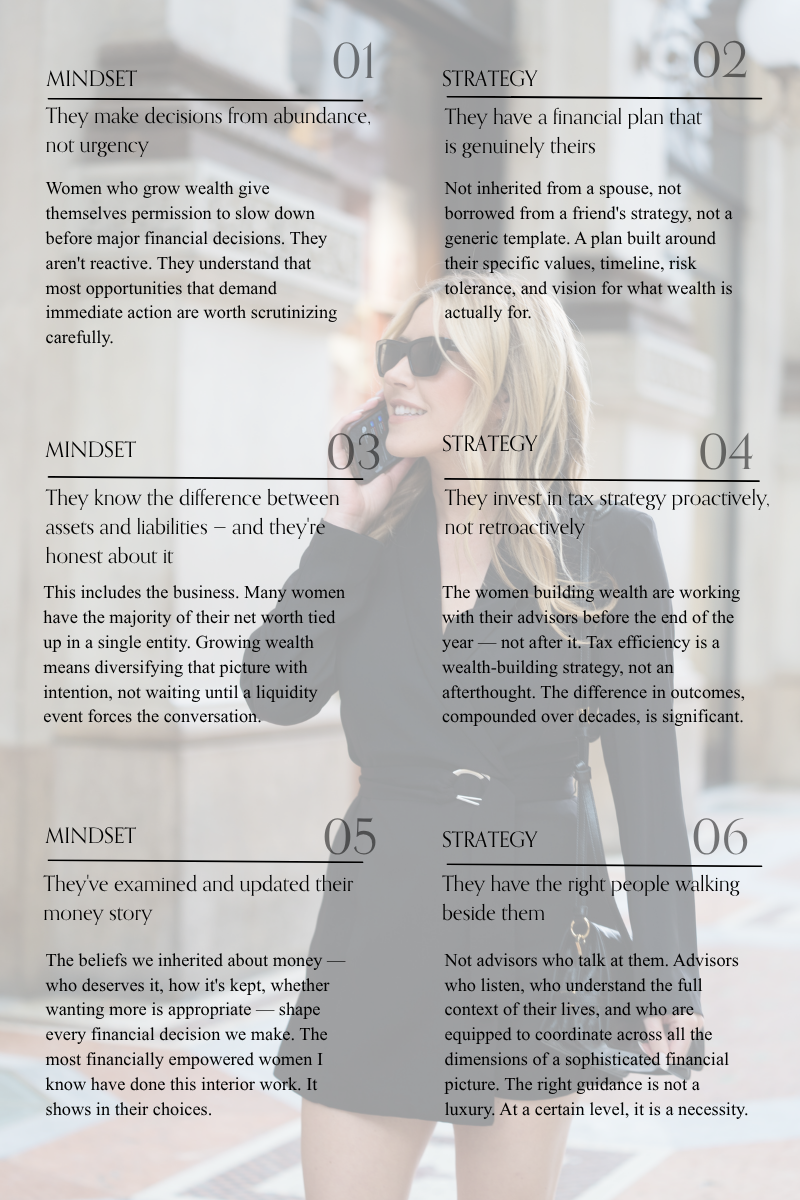
Six Habits Worth Examining:
The real question isn't about the market — it's about your next move
A Final Reflection:
I started Infinite Heights because I believed — and still believe — that women who have built real things deserve planning that rises to meet the complexity of what they've created. Too often, the financial industry either talks down to women or overlooks the nuance of their situations entirely.
What I know for certain is this: the women who grow wealth aren't the ones who have it all figured out. They're the ones who have decided to stop navigating alone. They've invested in clarity. They've built a strategy that reflects who they actually are and where they are actually going — and they revisit that strategy with the same rigor they bring to everything else they've built.
That is the work. And it is deeply worth doing.
*The opinions voiced are for general information only and are not intended to provide specific advice or recommendations for any individual. The content is developed from sources believed to be providing accurate information. The information in this material is not intended as tax or legal advice. It may not be used for the purpose of avoiding any federal tax penalties. Please consult legal or tax professionals for specific information regarding your individual situation.