
April Market Recap
April was a month that tested a lot of us — and then quietly rewarded those who stayed the course.
I want to be honest with you: the backdrop wasn't easy. Geopolitical tension in the Middle East. Oil prices swinging by nearly $30 a barrel in a single month. Jerome Powell stepping down as Fed Chair after seven years. A Fed committee more divided than it's been since 1992. Any one of those things would have been enough to rattle markets. Together, they made for a lot of anxious headlines.
And yet — the S&P 500 gained 10.4% in April alone. The Nasdaq climbed 15.3%. Both closed the month at all-time highs.
I've been doing this long enough to know that moments like this are exactly why we build portfolios the way we do.
What the numbers showed us
The Dow gained 7.1%, while small caps jumped 12.2% and mid-caps rose 7.8%
Emerging markets surged 14.5%, and international developed markets gained 7.0%
The VIX — a measure of market anxiety — fell from 25.3 to 16.9 as conditions improved
Bonds were essentially flat; the 10-year Treasury ended the month at 4.37%
Brent crude closed at $114/barrel (swinging between $92–$121), with WTI at $105, as the Strait of Hormuz remained closed to shipping
Gold settled at $4,610/oz, and the dollar eased slightly to 98.1
After a difficult first quarter, the S&P 500 is now up 5.3% for the year. Not bad, considering where sentiment was just a few weeks ago.
What I want you to take away from this
When markets are falling, it can feel like something is fundamentally broken. I hear it from clients — "Should we do something? Should we move things around?" I understand that impulse completely. It comes from a place of wanting to protect what you've worked hard to build.
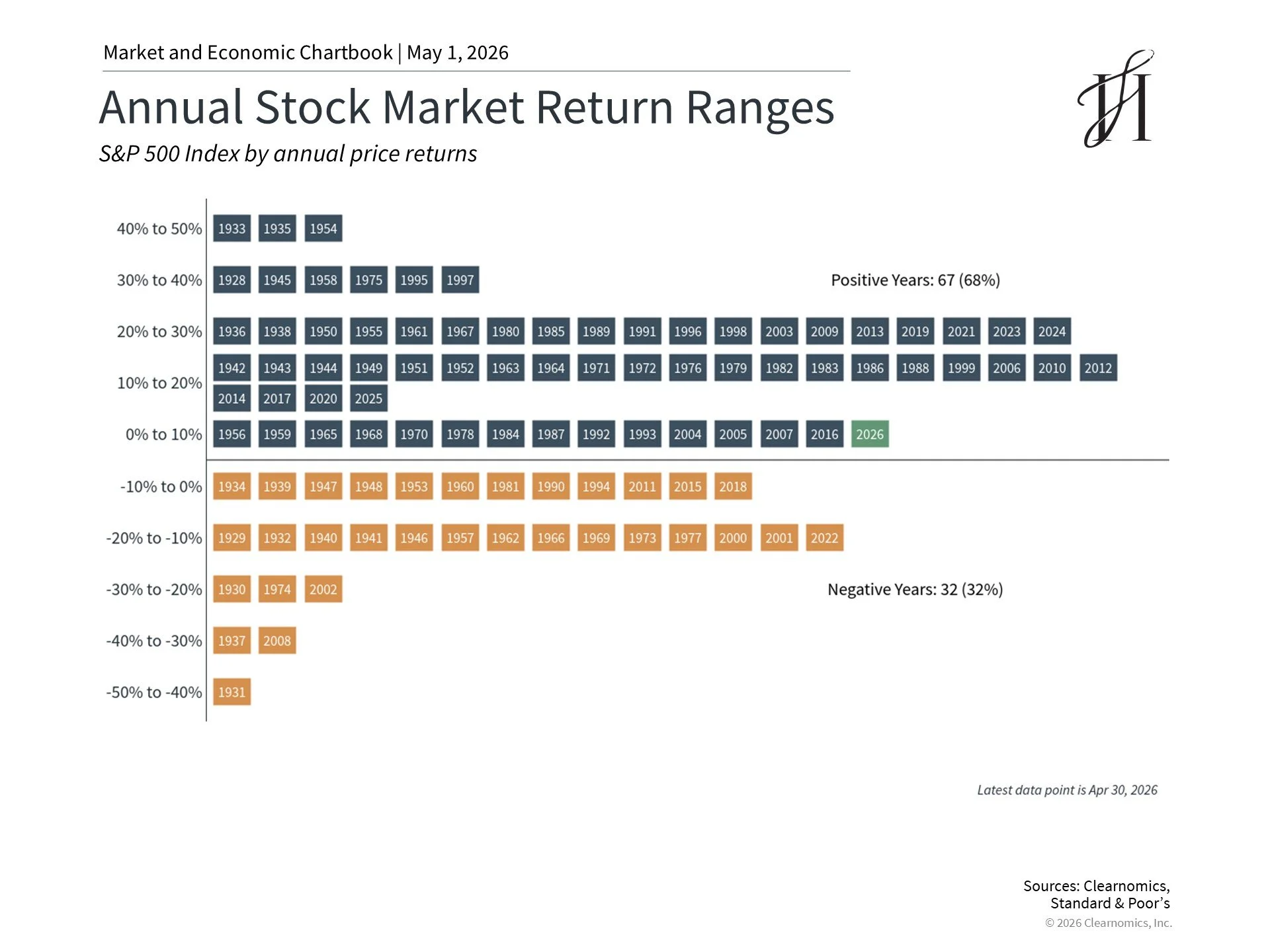
But history is pretty consistent here. Going back to 1928, markets have been positive roughly two-thirds of years. Since 1980, that number climbs to about three-quarters. The rebounds that matter most tend to happen when people least expect them — and often when the news still feels scary. We've seen this after 2020. After 2022. After early 2025.
The goal of a well-constructed portfolio isn't to avoid all volatility. It's to make sure you're still in the game when the market turns.
A few things I'm watching closely
The Fed held rates steady at 3.50%–3.75%, but the decision was far from united. The committee is navigating a genuine tension: a softening labor market that would normally call for rate cuts, alongside oil-driven inflation that argues for caution. For the first time in a while, markets are pricing in roughly even odds of a cut or a hike later this year — which tells you something about how uncertain the path forward is.
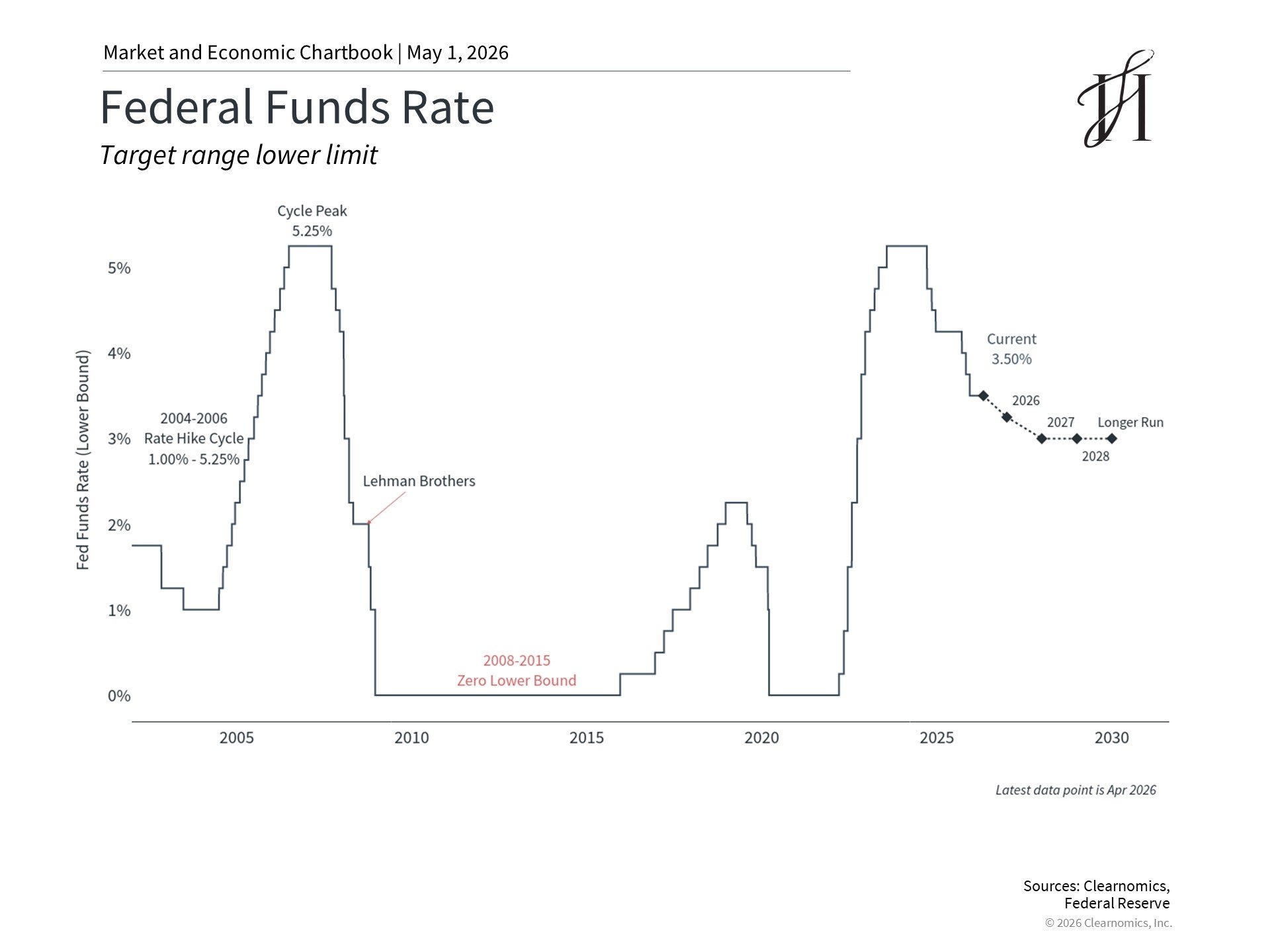
Supporting the job market would normally result in rate cuts, while fighting inflation would call for rate hikes. As a result, market expectations for the next Fed move have shifted to reflect roughly even odds between a rate cut and a rate hike later this year.
This was also Jerome Powell’s final press conference as Fed Chair. He has served in the role since taking over from Janet Yellen in 2018, and has been on the Board of Governors since 2012. The next Fed Chair is expected to be Kevin Warsh, whose nomination has been approved by the Senate Banking Committee. Powell stated at the press conference that he will not leave the Fed’s Board of Governors until legal actions from the Justice Department are resolved, and that he intends to serve in a manner that is respectful of the incoming Chair.
While a change in Fed leadership adds a layer of uncertainty as to how the Fed is likely to proceed, the reality is that both markets and the economy have performed well across many Fed Chairs and monetary policy environments. Ultimately, a well-diversified portfolio is designed to manage through this kind of policy uncertainty.
Oil prices and the Strait of Hormuz
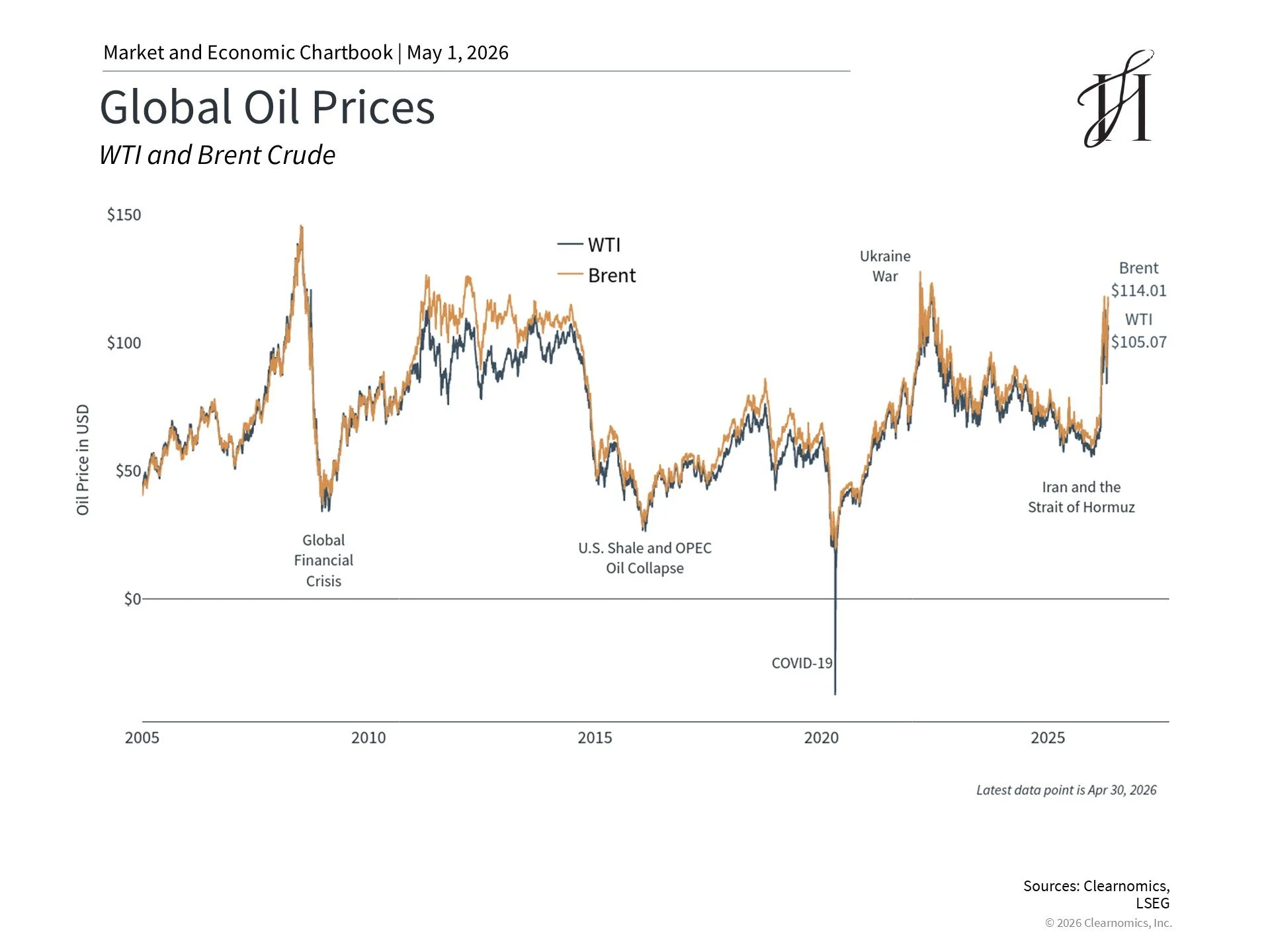
On the oil front — I'm watching whether sustained energy prices start to affect the broader economy beyond just gas prices. That's the real risk worth monitoring. For now, the U.S. being the world's largest oil and gas producer gives us more of a buffer than we've had in decades. Oil prices remain one of the most direct channels through which the conflict in Iran affects everyday investors and consumers. Brent crude and WTI prices climbed back toward recent highs in April as the Strait of Hormuz remained effectively closed to oil shipping. There were a number of false starts over the past month regarding ceasefires and peace deal negotiations, which whipsawed markets.
Still, the stock market has performed well despite higher oil prices. The more significant concern for investors is whether energy costs will begin to spread to other parts of the economy. This “second-order effect” would occur if oil and gasoline prices remain high for an extended period, increasing transportation and energy input costs for businesses that are then passed onto consumers via higher prices for goods and services.
That said, it is worth maintaining some perspective. The history of oil shocks suggests that inflation effects can fade once the underlying situation stabilizes. The 2022 spike in U.S. gasoline prices above $5 per gallon proved to be short-lived as supply conditions improved, even if it did create challenges for household budgets. Also, it is worth noting that the U.S. remains the world’s largest producer of oil and natural gas, which provides some insulation from global supply disruptions compared to prior decades.
The bigger picture
What April reminded me — and what I hope it reminded you — is that the discomfort of staying invested during uncertain times is part of the process, not a sign that something has gone wrong.
You don't have to have it all figured out. That's what we're here for. At Infinite Heights, our role is to help you stay focused on the bigger picture. We continuously monitor market developments, evaluate opportunities, and make adjustments when appropriate so that your portfolio continues to support your long term vision.
If you have questions about how current market conditions relate to your plan, we always welcome the conversation. Your financial plan should evolve alongside your life, and we are here to guide you every step of the way.
Securities and advisory services offered through LPL Financial, a Registered Investment Advisor, Member FINRA/SIPC.
Copyright (c) 2026 Clearnomics, Inc. All rights reserved. The information contained herein has been obtained from sources believed to be reliable, but is not necessarily complete and its accuracy cannot be guaranteed. No representation or warranty, express or implied, is made as to the fairness, accuracy, completeness, or correctness of the information and opinions contained herein. The views and the other information provided are subject to change without notice. All reports posted on or via www.clearnomics.com or any affiliated websites, applications, or services are issued without regard to the specific investment objectives, financial situation, or particular needs of any specific recipient and are not to be construed as a solicitation or an offer to buy or sell any securities or related financial instruments. Past performance is not necessarily a guide to future results. Company fundamentals and earnings may be mentioned occasionally, but should not be construed as a recommendation to buy, sell, or hold the company's stock. Predictions, forecasts, and estimates for any and all markets should not be construed as recommendations to buy, sell, or hold any security--including mutual funds, futures contracts, and exchange traded funds, or any similar instruments. The text, images, and other materials contained or displayed in this report are proprietary to Clearnomics, Inc. and constitute valuable intellectual property. All unauthorized reproduction or other use of material from Clearnomics, Inc. shall be deemed willful infringement(s) of this copyright and other proprietary and intellectual property rights, including but not limited to, rights of privacy. Clearnomics, Inc. expressly reserves all rights in connection with its intellectual property, including without limitation the right to block the transfer of its products and services and/or to track usage thereof, through electronic tracking technology, and all other lawful means, now known or hereafter devised. Clearnomics, Inc. reserves the right, without further notice, to pursue to the fullest extent allowed by the law any and all criminal and civil remedies for the violation of its rights.