
The first quarter of 2026 served as a reminder of why preparation matters when it comes to financial planning and investing.
After a strong 2025, markets entered the year facing a mix of geopolitical tension, rising oil prices, and renewed uncertainty. The conflict in Iran, which escalated at the end of February, quickly became the dominant story—driving oil prices higher and leading to the first meaningful pullback of the year.
By the end of March, however, headlines began to shift toward a potential ceasefire. It was a clear example of how quickly market sentiment can change—and why reacting to short-term news cycles can be difficult to get right.
Zooming out, the broader picture remains more constructive. Over the past twelve months, markets have still delivered strong results, and beneath the surface, portfolios have been supported by areas like energy and more defensive sectors.
As we look ahead, new questions will continue to emerge—from changes in Federal Reserve leadership to the midterm election later this year. But that’s always the case. Markets evolve, and so does the narrative around them.
For long-term investors, this quarter reinforces a simple truth: markets rarely move in a straight line, and the principles of sound investing matter most when uncertainty is at its highest.
Key Market and Economic Drivers
The S&P 500 declined -4.3% in Q1, while the Nasdaq fell -7.0% and the Dow Jones Industrial Average declined -3.2%.
The Bloomberg U.S. Aggregate Bond Index was flat for the quarter. The 10-year Treasury yield ended at 4.3%, after falling as low as 3.9% in February.
Developed international stocks (MSCI EAFE) were down -1.1%, while emerging markets (MSCI EM) declined -0.1% in U.S. dollar terms.
Oil prices surged, with Brent crude reaching $118 per barrel and WTI ending the quarter at $101.
Gold ended the quarter at $4,668 per ounce after peaking earlier in the year, while the U.S. Dollar Index strengthened modestly.
Inflation remained relatively stable, with CPI at 2.4% year-over-year and core inflation slightly higher.
The Federal Reserve held rates steady in a range of 3.50% to 3.75% throughout the quarter.
Markets Experienced Their First Pullback of the Year
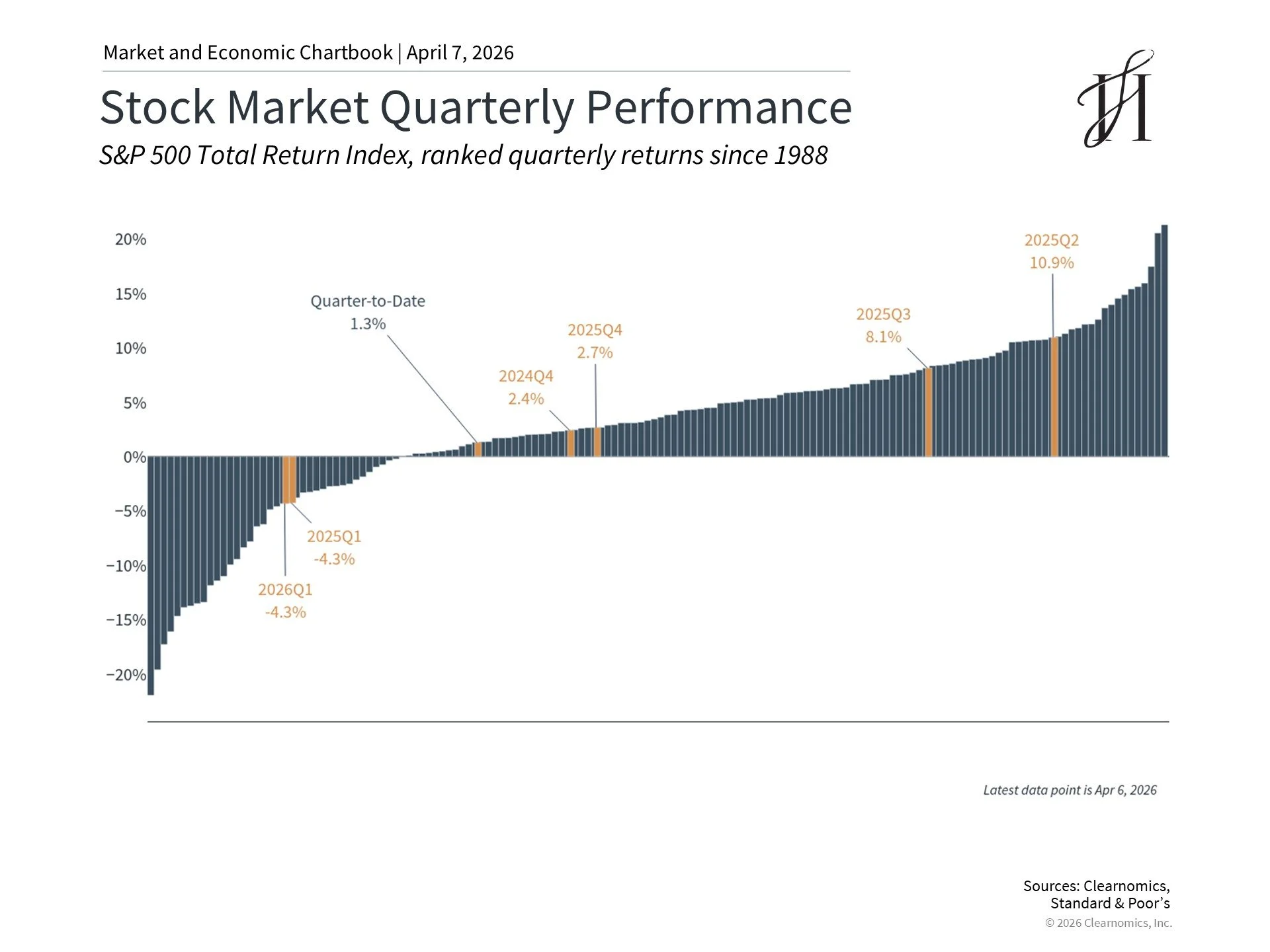
Markets saw their first pullback of the year—and while the catalyst may feel new, the pattern is not.
We saw a similar start to 2025, where global concerns drove early volatility. In both cases, investor sentiment shifted quickly in response to headlines.
The reality is that pullbacks are not the exception—they’re a normal part of investing. Since 1980, the S&P 500 has experienced average intra-year declines of around 15%, even in years that ultimately finished positive. It’s also common to see multiple pullbacks of 5% or more within a single year.
For our clients, this is exactly why portfolios are built with diversification and discipline at the core—not to avoid volatility, but to navigate it. Periods like this are expected, and they are already accounted for in a long-term strategy.
Geopolitics and Oil Prices Drove Uncertainty
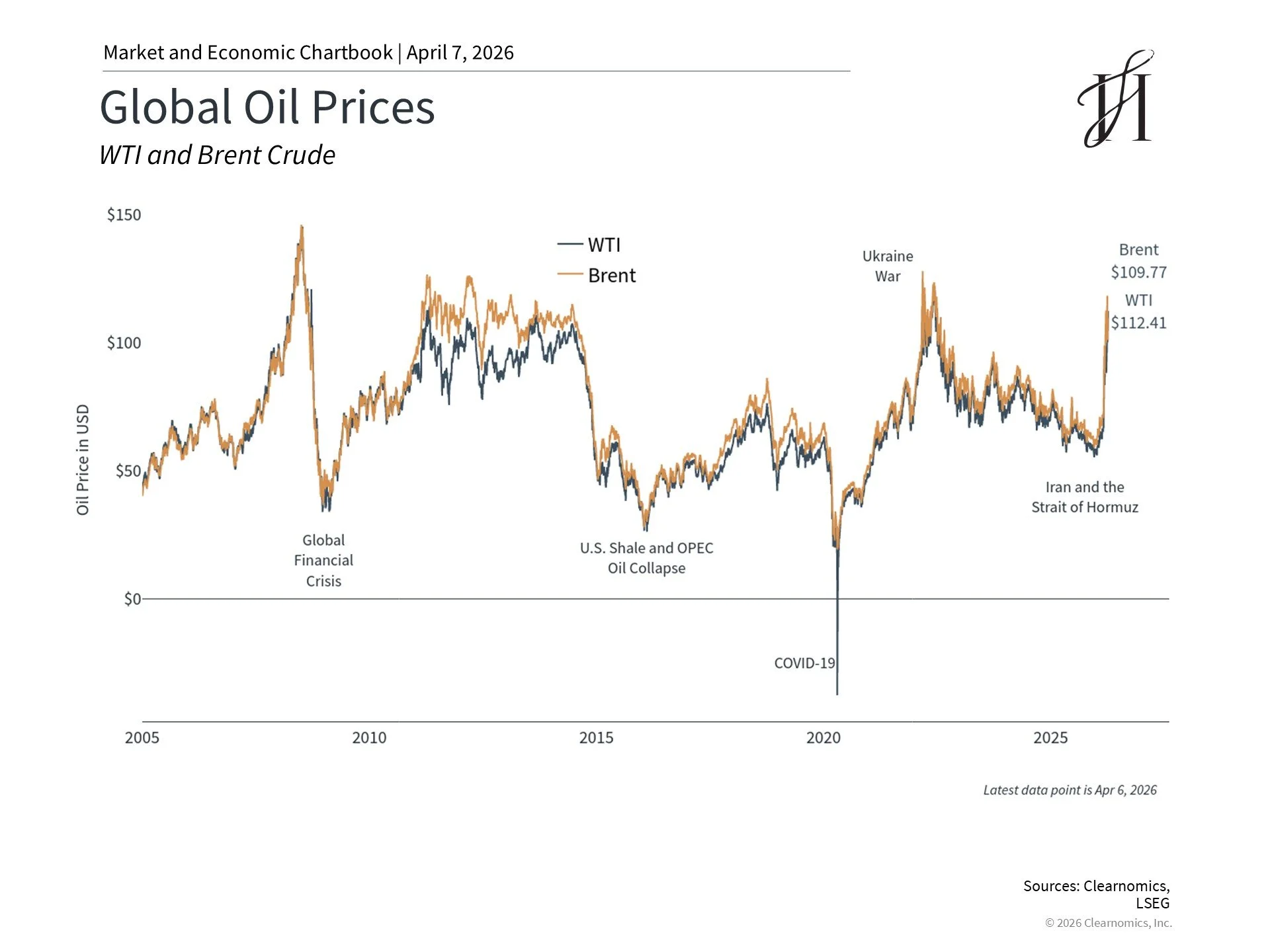
The most significant driver this quarter was geopolitical tension in the Middle East, which pushed oil prices sharply higher.
Disruptions to key supply routes, including the Strait of Hormuz, created concerns around global energy availability and led to production cuts across major oil-producing nations. As a result, oil prices rose quickly, impacting everything from transportation costs to consumer goods.
These types of events can feel alarming—and they do have real-world effects, especially at the gas pump. However, history shows that these are typically short-term disruptions rather than long-term structural issues for markets.
We saw a similar pattern in 2022, when gas prices spiked before stabilizing within a matter of months.
While the current situation is still evolving and the humanitarian impact is significant, it’s important for investors to separate emotional reactions from long-term decision-making. Historically, making major portfolio changes during geopolitical events has often led to poor timing.
Economic Growth Is Slowing, But Still Healthy
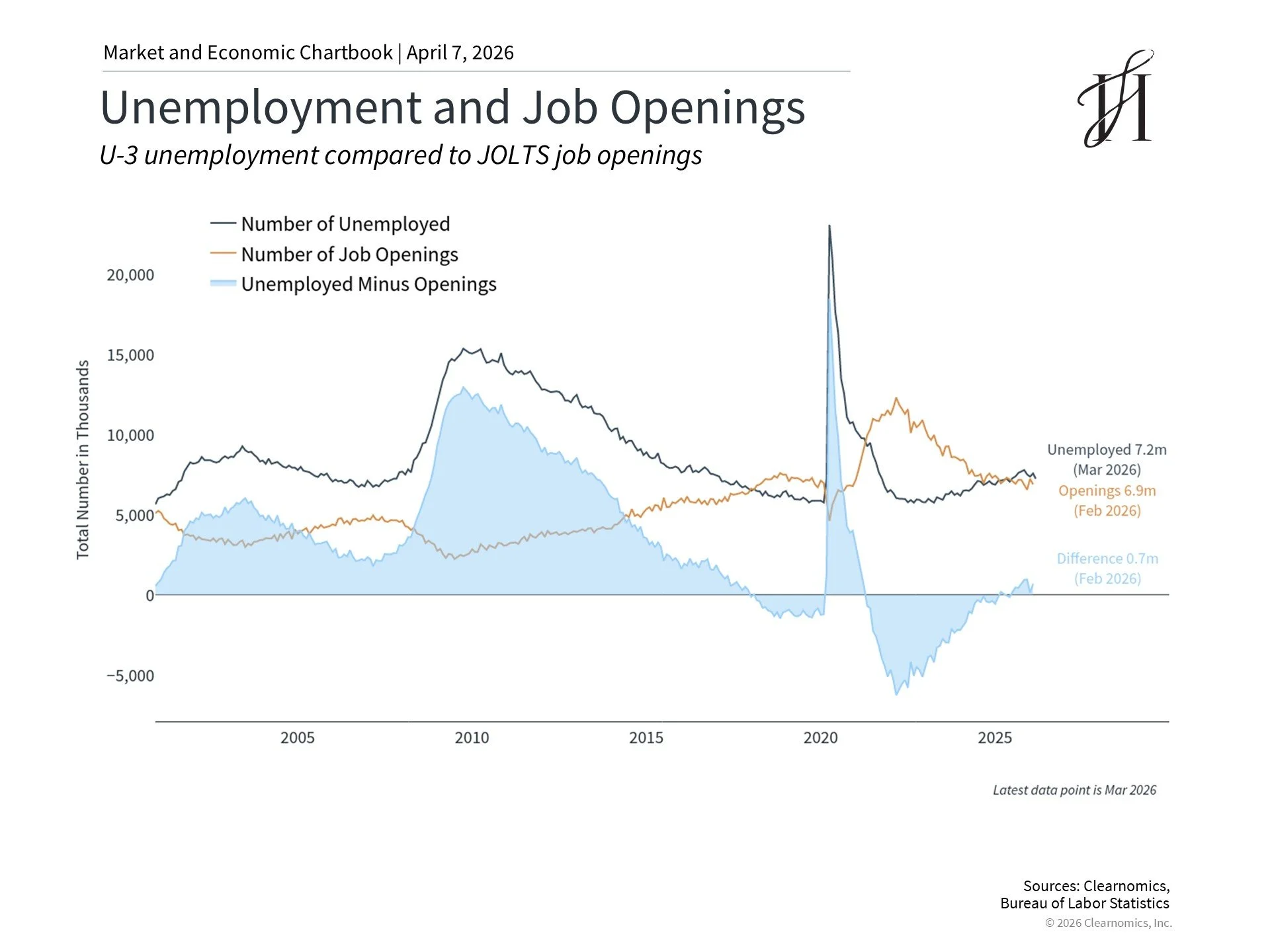
Beyond energy markets, the broader economy continues to show signs of cooling—but remains fundamentally stable.
The labor market is one of the most closely watched indicators. Recent data shows job growth slowing and the unemployment rate ticking slightly higher to 4.4%. For the first time in several years, job seekers now outnumber job openings.
At first glance, this may seem concerning. But context matters.
The labor market is normalizing from historically tight conditions, driven in part by demographic trends like an aging population and lower workforce participation. Both labor supply and demand are easing, which has helped keep unemployment at relatively healthy levels.
Consumer spending, which makes up more than two-thirds of the U.S. economy, has also remained more resilient than many expected.
While growth may not be as strong as in recent years, the foundation of the economy remains intact.
A Wider Gap Between Winners and Losers
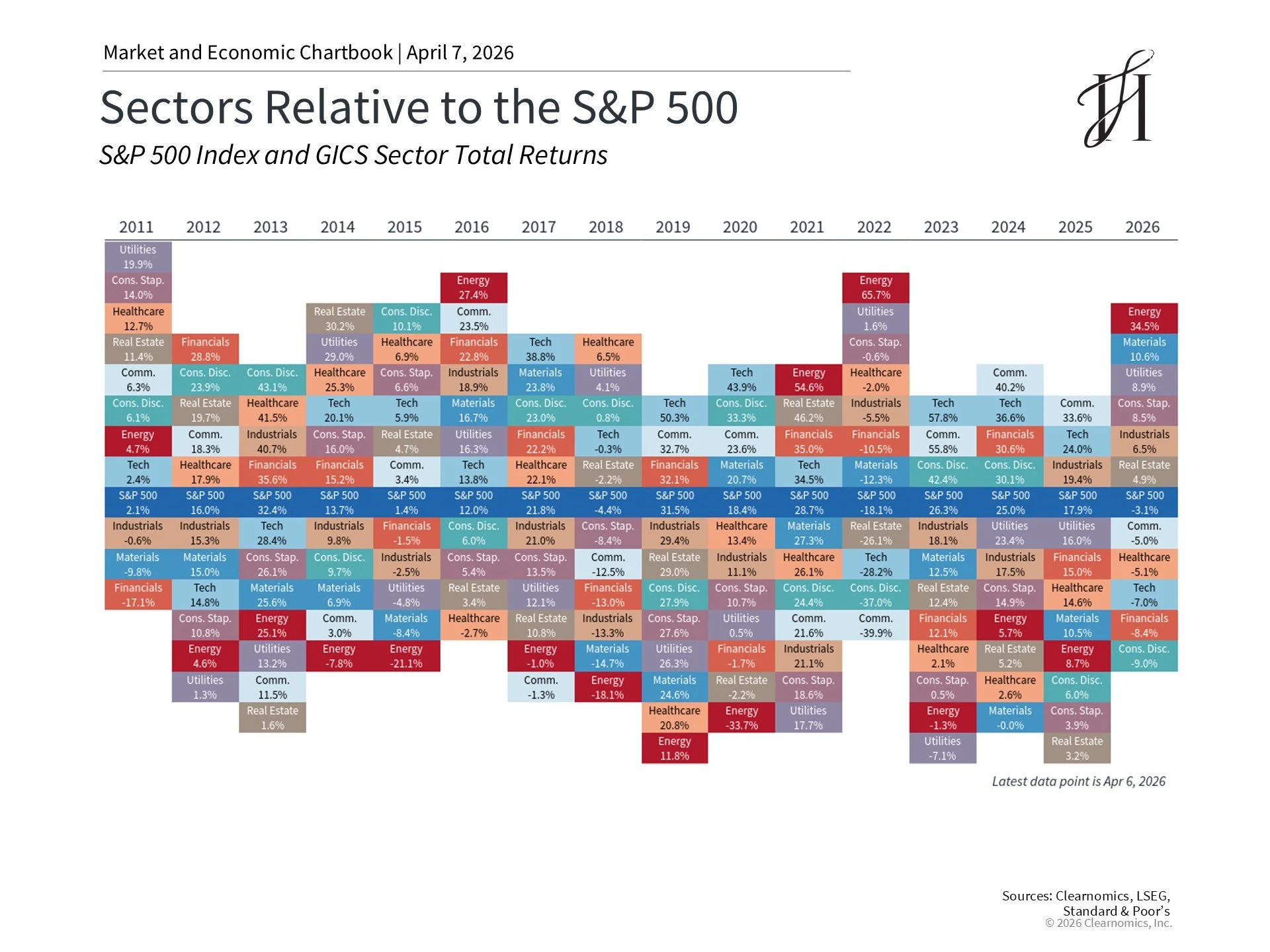
While broad market indices declined this quarter, performance beneath the surface tells a more nuanced story.
Six of the eleven sectors in the S&P 500 are actually positive for the year, and the gap between top and bottom performers has widened significantly.
Energy has been the clear leader, benefiting from rising oil prices. Other areas like Consumer Staples, Utilities, Materials, and Industrials have also held up well, as investors have gravitated toward more defensive parts of the market.
On the other hand, the Information Technology sector has declined, with several large-cap names underperforming after years of leading market gains.
This shift is a good reminder that leadership in the market is constantly evolving. Just as technology dominated in recent years, other sectors can—and do—take the lead in different environments.
For investors, this reinforces the importance of diversification. It’s extremely difficult to predict which areas of the market will outperform in any given year, but a well-balanced portfolio is designed to participate across different conditions.
Trade Policy Continues to Evolve
Trade policy also shifted this quarter following a Supreme Court ruling that challenged the legal basis for certain tariffs.
While the administration has adjusted its approach, the broader direction of trade policy remains intact. Tariffs will likely continue to influence areas like consumer prices, business costs, and overall market sentiment.
However, markets have shown an ability to adapt to these types of policy changes over time.
As with many of the themes this quarter, the details may evolve—but the importance of staying focused on long-term strategy does not.
What This Means For Our Clients
The first quarter of 2026 tested markets with geopolitical shocks, rising oil prices, and economic uncertainty.
But this is exactly what well-constructed portfolios and thoughtful financial plans are designed for.
For our clients, the focus remains on maintaining a thoughtful, diversified strategy that is aligned with your long term goals, your cash flow needs, and the life you are building. When markets rotate between sectors, when interest rates move, or when global events create uncertainty, diversification and disciplined planning are what provide stability.
At Infinite Heights, our role is to help you stay focused on the bigger picture. We continuously monitor market developments, evaluate opportunities, and make adjustments when appropriate so that your portfolio continues to support your long term vision.
If you have questions about how current market conditions relate to your plan, we always welcome the conversation. Your financial plan should evolve alongside your life, and we are here to guide you every step of the way.
Securities and advisory services offered through LPL Financial, a Registered Investment Advisor, Member FINRA/SIPC.
Copyright (c) 2026 Clearnomics, Inc. All rights reserved. The information contained herein has been obtained from sources believed to be reliable, but is not necessarily complete and its accuracy cannot be guaranteed. No representation or warranty, express or implied, is made as to the fairness, accuracy, completeness, or correctness of the information and opinions contained herein. The views and the other information provided are subject to change without notice. All reports posted on or via www.clearnomics.com or any affiliated websites, applications, or services are issued without regard to the specific investment objectives, financial situation, or particular needs of any specific recipient and are not to be construed as a solicitation or an offer to buy or sell any securities or related financial instruments. Past performance is not necessarily a guide to future results. Company fundamentals and earnings may be mentioned occasionally, but should not be construed as a recommendation to buy, sell, or hold the company's stock. Predictions, forecasts, and estimates for any and all markets should not be construed as recommendations to buy, sell, or hold any security--including mutual funds, futures contracts, and exchange traded funds, or any similar instruments. The text, images, and other materials contained or displayed in this report are proprietary to Clearnomics, Inc. and constitute valuable intellectual property. All unauthorized reproduction or other use of material from Clearnomics, Inc. shall be deemed willful infringement(s) of this copyright and other proprietary and intellectual property rights, including but not limited to, rights of privacy. Clearnomics, Inc. expressly reserves all rights in connection with its intellectual property, including without limitation the right to block the transfer of its products and services and/or to track usage thereof, through electronic tracking technology, and all other lawful means, now known or hereafter devised. Clearnomics, Inc. reserves the right, without further notice, to pursue to the fullest extent allowed by the law any and all criminal and civil remedies for the violation of its rights.