
Special Update: Iran and Long-Term Investing
Major geopolitical events often create uncertainty and strong reactions in financial markets. In the past several days, news has emerged that the United States and Israel launched military strikes against Iran targeting leadership, military assets, and nuclear infrastructure. Iran’s Supreme Leader has reportedly been killed, and Iran has responded with missile and drone attacks across the Middle East.
President Trump has stated that the objective of the operation, referred to as “Operation Epic Fury,” is regime change in Tehran, with military activity expected to continue for weeks. There have already been reports of U.S. troop casualties.
The situation is evolving rapidly. The safety of civilians in the region and our service members is the most important consideration.
At the same time, events like this naturally raise questions for investors. When geopolitical tensions rise, many people wonder what it means for markets, oil prices, and their long term financial plans.
President Dwight D. Eisenhower once said that “plans are worthless, but planning is everything.” This idea is particularly relevant during moments of global uncertainty. While specific geopolitical events are impossible to predict, the reality that markets will face wars, crises, and political conflict is not new.
The purpose of thoughtful financial planning and disciplined portfolio construction is to prepare for uncertainty. Markets have navigated countless global events throughout history. While each event is unique, the long term drivers of markets remain economic growth, corporate earnings, and innovation.
For investors, the key is separating geopolitical headlines from long term investment decisions.
This Is the Latest Chapter in a Long Story
Although the scale of the current strikes is significant, tensions between the United States, Israel, and Iran have been building for years. The latest developments follow a month long U.S. military buildup in the region, failed negotiations over Iran’s nuclear program, and increasing political unrest inside Iran earlier this year.
Looking at the broader timeline provides helpful context.
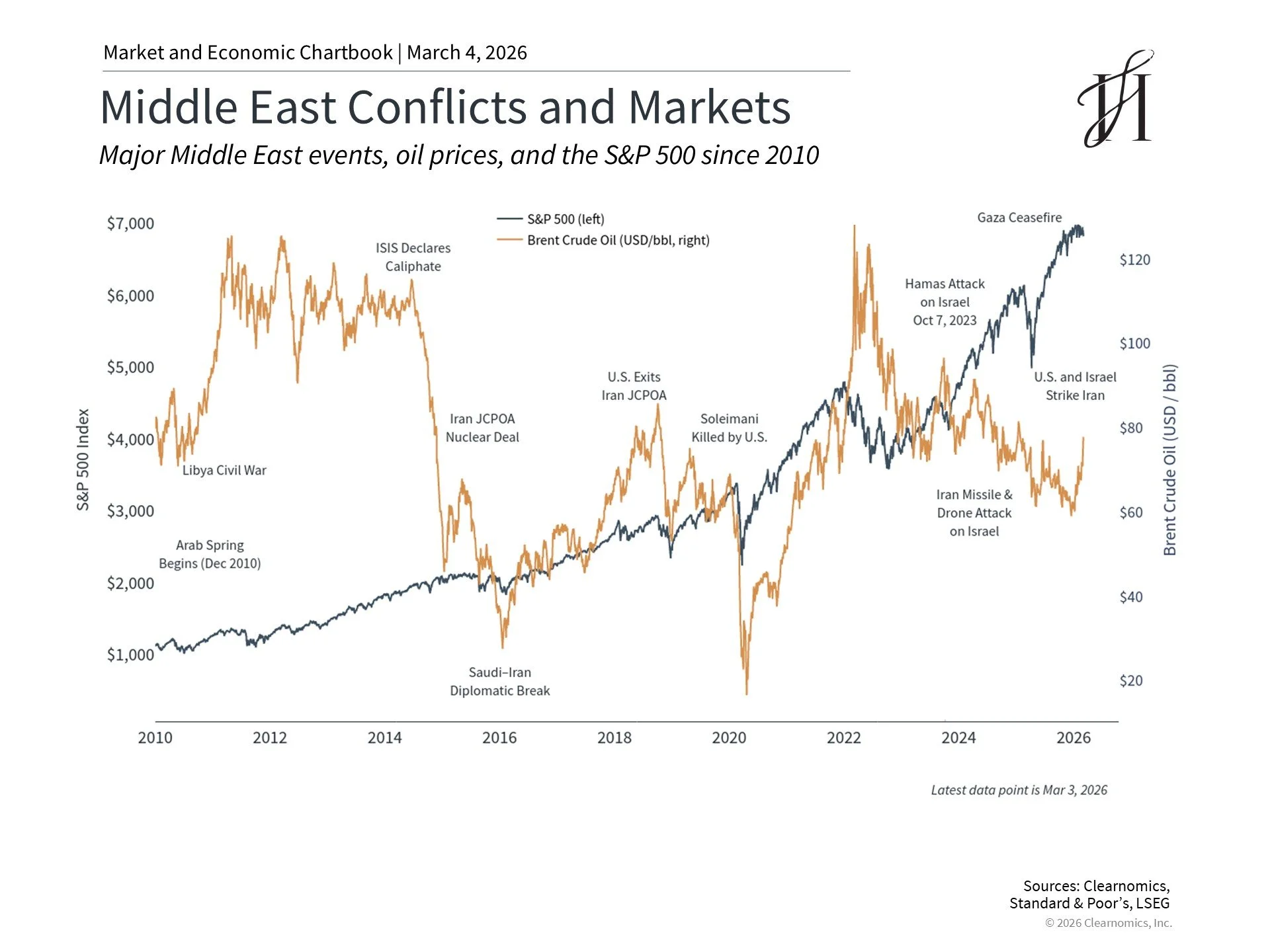
Tensions between Iran and Western countries stretch back decades. The Iranian regime has long supported organizations such as Hezbollah and Hamas, which have played central roles in conflicts throughout the Middle East.
In 2019, Iran launched drone attacks against Saudi Arabia’s oil infrastructure, temporarily disrupting global oil supply and raising concerns about a wider regional conflict.
In October 2023, Hamas attacked Israel, reigniting violence in the region and eventually drawing in Hezbollah and escalating tensions with Iran.
Last summer, Israel conducted a twelve day military campaign targeting Iran’s nuclear and ballistic missile programs. This marked the most direct confrontation between the two countries in decades.
Earlier this year, protests inside Iran challenged the regime, with the United States publicly voicing support for protesters.
Negotiations over Iran’s nuclear program ultimately failed to produce an agreement. In recent weeks, a substantial U.S. military buildup signaled that a broader operation could be approaching, culminating in the current strikes.
While the escalation is serious, history shows that geopolitical conflicts do not always translate into sustained market disruption.
Oil, Energy Markets, and the Strait of Hormuz
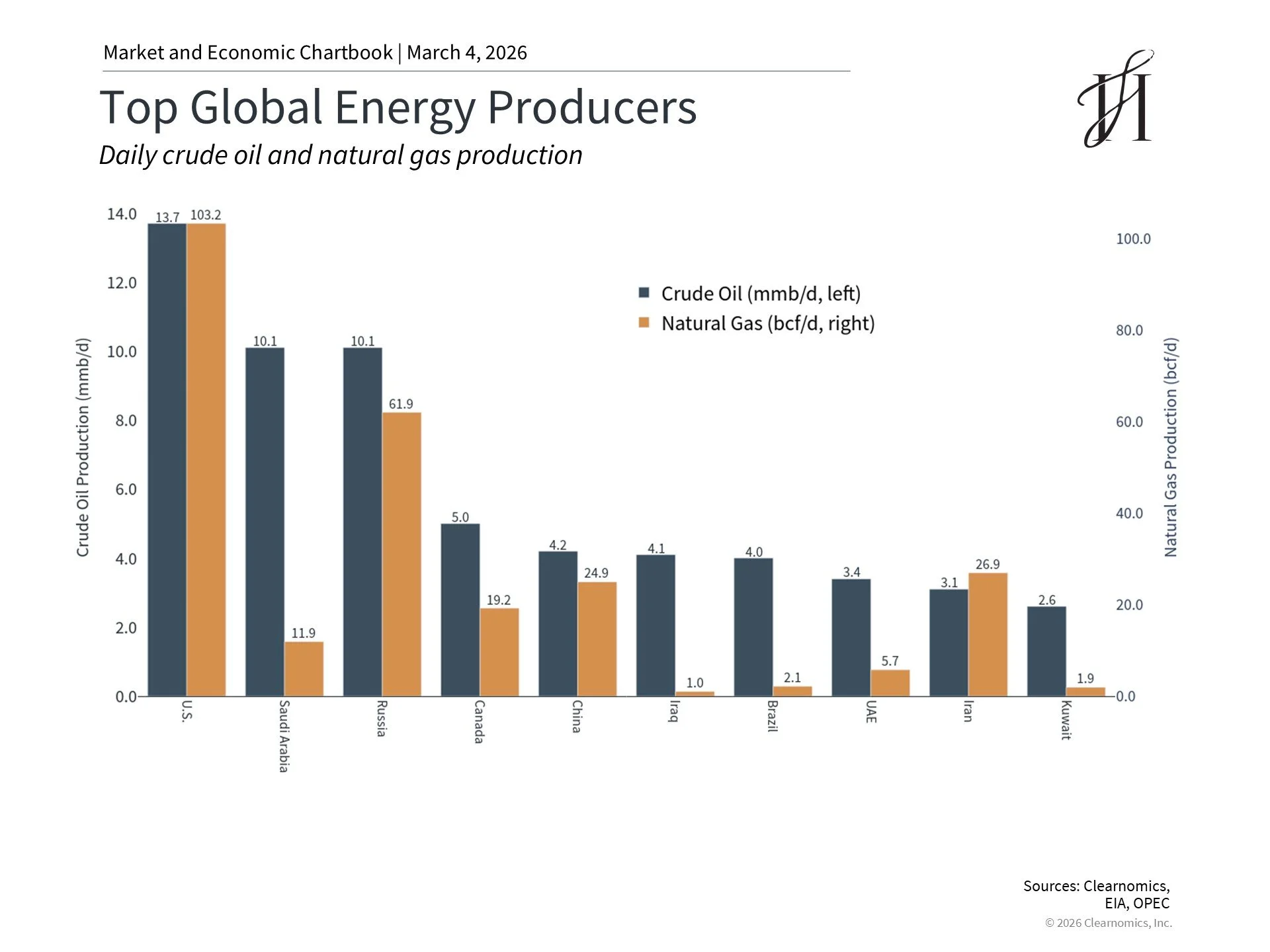
For investors, the most direct channel through which Middle East conflicts affect markets is energy prices.
Iran is a member of OPEC and produces roughly three million barrels of oil per day, along with significant natural gas output. The country also borders the Strait of Hormuz, one of the most critical energy transportation routes in the world. According to the U.S. Energy Information Administration, approximately one third of global seaborne oil exports and about one fifth of natural gas flows through this narrow waterway.
Any disruption or perceived risk to this route can influence global energy prices.
Oil prices had already been rising in anticipation of the strikes. Following the announcement, prices moved higher, with West Texas Intermediate crude trading in the low $70 range and Brent crude just under $80.
Although Western countries do not directly import oil from Iran, the global energy market is interconnected. Any disruption in supply can influence prices worldwide.
However, some perspective is important. Oil prices today remain well below the 2022 peak of nearly $128 per barrel during the early stages of the Russia Ukraine war.
The global energy landscape has also changed in recent years. In 2018, the United States became the world’s largest producer of oil and natural gas. Domestic production now exceeds that of Saudi Arabia and Russia. While the United States still participates in global energy markets, this level of production helps reduce the economy’s vulnerability to external supply disruptions.
It is also worth remembering that oil prices are extremely difficult to predict. When Russia invaded Ukraine, many analysts expected oil prices to remain elevated for years. Instead, prices stabilized and declined much sooner than projected.
Similarly, the U.S. military operation in Venezuela earlier this year caused a brief move in oil prices but had little lasting impact on markets.
Staying Invested Through Geopolitical Uncertainty
Periods like this can understandably feel unsettling. Headlines describing military strikes, retaliation, and the possibility of broader conflict carry real human consequences and are very different from the usual flow of market news about earnings and economic data.
However, history consistently shows that financial markets have navigated even the most serious global conflicts.
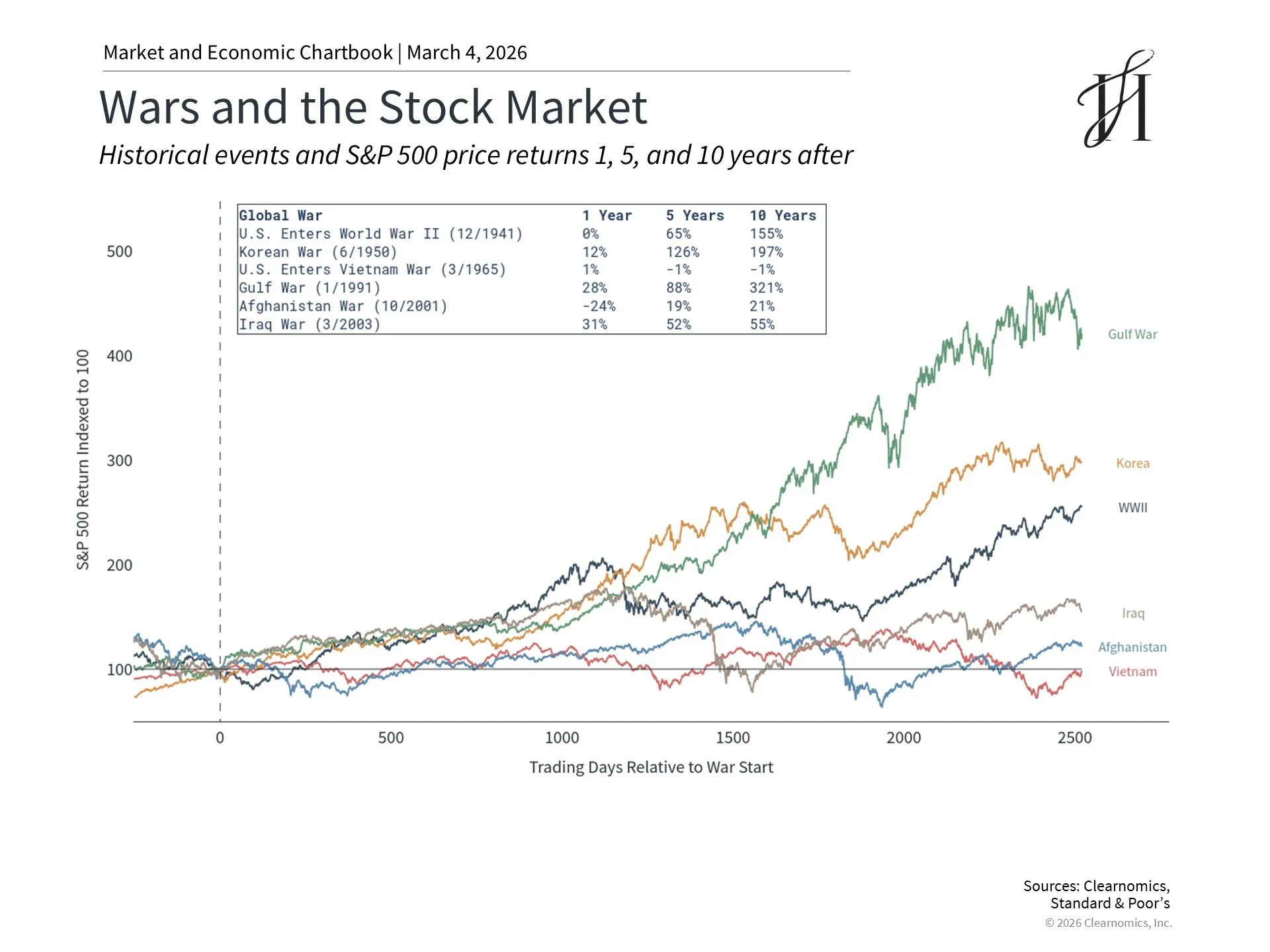
From World War II to the Gulf War to the wars in Iraq and Afghanistan, markets experienced periods of short term volatility but ultimately continued to be driven by economic fundamentals over the long run.
More recently, conflicts involving Russia and Ukraine and the war between Israel and Hamas created uncertainty but did not derail the long term trajectory of global markets.
It is also important to note that Iran plays a minimal direct role in most investment portfolios. The country has been under significant sanctions for many years and its economy has experienced severe instability, including hyperinflation and a collapse of its currency. As a result, most diversified portfolios have little to no direct exposure to Iran.
Markets may experience volatility in the coming days or weeks as the situation unfolds. Oil prices could move higher and investor sentiment may shift as new information emerges.
Historically, however, trying to time markets during geopolitical events has proven counterproductive. Some of the strongest market rebounds occur unexpectedly, and missing even a few of the best trading days can significantly reduce long term investment returns.
What This Means for Our Clients
At Infinite Heights Wealth Management, our approach to investing is intentionally designed to navigate uncertainty like this.
Your portfolio is built around diversification, long term strategy, and disciplined decision making rather than short term reactions to headlines. While geopolitical events can create temporary market volatility, history consistently shows that markets reward patience and long term thinking.
Our focus remains on the factors we can control. Maintaining a thoughtful investment strategy, managing risk appropriately, and ensuring your financial plan continues to align with your long term goals.
We will continue monitoring developments closely. If changes become necessary within portfolios or financial plans, we will address them thoughtfully and proactively.
For now, the most important thing investors can do is remain focused on the long term plan.
Securities and advisory services offered through LPL Financial, a Registered Investment Advisor, Member FINRA/SIPC.
Copyright (c) 2026 Clearnomics, Inc. All rights reserved. The information contained herein has been obtained from sources believed to be reliable, but is not necessarily complete and its accuracy cannot be guaranteed. No representation or warranty, express or implied, is made as to the fairness, accuracy, completeness, or correctness of the information and opinions contained herein. The views and the other information provided are subject to change without notice. All reports posted on or via www.clearnomics.com or any affiliated websites, applications, or services are issued without regard to the specific investment objectives, financial situation, or particular needs of any specific recipient and are not to be construed as a solicitation or an offer to buy or sell any securities or related financial instruments. Past performance is not necessarily a guide to future results. Company fundamentals and earnings may be mentioned occasionally, but should not be construed as a recommendation to buy, sell, or hold the company's stock. Predictions, forecasts, and estimates for any and all markets should not be construed as recommendations to buy, sell, or hold any security--including mutual funds, futures contracts, and exchange traded funds, or any similar instruments. The text, images, and other materials contained or displayed in this report are proprietary to Clearnomics, Inc. and constitute valuable intellectual property. All unauthorized reproduction or other use of material from Clearnomics, Inc. shall be deemed willful infringement(s) of this copyright and other proprietary and intellectual property rights, including but not limited to, rights of privacy. Clearnomics, Inc. expressly reserves all rights in connection with its intellectual property, including without limitation the right to block the transfer of its products and services and/or to track usage thereof, through electronic tracking technology, and all other lawful means, now known or hereafter devised. Clearnomics, Inc. reserves the right, without further notice, to pursue to the fullest extent allowed by the law any and all criminal and civil remedies for the violation of its rights.