
2026 Market Outlook
It’s that time of year again. The inbox fills up with 2026 market outlooks, bold predictions, and confident declarations about what the markets will do next.
If you’ve worked with me for any length of time, you’ve heard me say this more times than you can count. No one has a crystal ball. Not strategists, not economists, not investment firms with the biggest research budgets. Markets don’t move in straight lines, and they certainly don’t move according to a single forecast.
That said, these outlooks can still be incredibly useful. Not because they tell us exactly what will happen, but because they help surface the themes that are consistently showing up across the board and give us a framework for thinking about risk, opportunity, and positioning.
At Infinite Heights, our goal is never to react to media headlines or make short-term portfolio shifts based on predictions. Instead, we focus on building thoughtful, diversified, long-term portfolios that can weather a wide range of outcomes. The work we do behind the scenes is about preparation, not prediction.
With that in mind, I want to share how we’re thinking about the year ahead, informed in part by LPL Research’s 2026 Market Outlook, and how these themes may show up in your portfolio.
First, let’s recap 2025
For the sixth time in the last seven years, the stock market is on track to deliver double-digit returns. Outside of the inflation-driven downturn in 2022, this has been a remarkably strong stretch for investors and one that has left many portfolios in a healthier position than people expected just a few years ago.
There’s an interesting dynamic that tends to show up in years like this. Investors hope for strong returns when markets are struggling, but once those returns actually arrive, nervousness often follows. When markets are near all-time highs and valuations are elevated, it’s natural to start wondering what comes next.
What made 2025 particularly notable is that returns weren’t driven by just one narrow corner of the market. Performance broadened beyond AI-related stocks, international markets rebounded meaningfully, and fixed income finally did what it’s supposed to do by providing both income and stability. From a portfolio construction standpoint, that combination matters.
At the same time, several long-running concerns began to ease. Inflation, while still felt at the household level, stabilized around 3%. Tariffs dominated headlines and drove short-term market swings, but ultimately did not create the economic disruption many feared. The Federal Reserve continued cutting rates, and the economy grew at a healthy pace.
When we zoom out, the biggest takeaway from 2025 may be a familiar one. What investors fear most often doesn’t come to pass. The recession that had been widely predicted since 2022 never materialized. History shows that for every true market disruption, like the 2008 financial crisis or the 2020 pandemic, there are dozens of anticipated “black swans” that never arrive.
This is why long-term investing isn’t about predicting the next headline or perfectly timing the market. It’s about maintaining perspective and discipline through all types of market environments.
As we turn our attention to 2026, the landscape brings both opportunity and uncertainty. The midterm election, leadership changes at the Federal Reserve, the continued evolution of AI, rising concerns around certain types of debt, currency movements, and global policy shifts will all compete for attention.
What matters most isn’t whether we can forecast each twist and turn. It’s whether your portfolio is positioned to weather uncertainty while continuing to support your long-term goals.
Key Themes We’re Watching as We Enter 2026
Diversification is working again
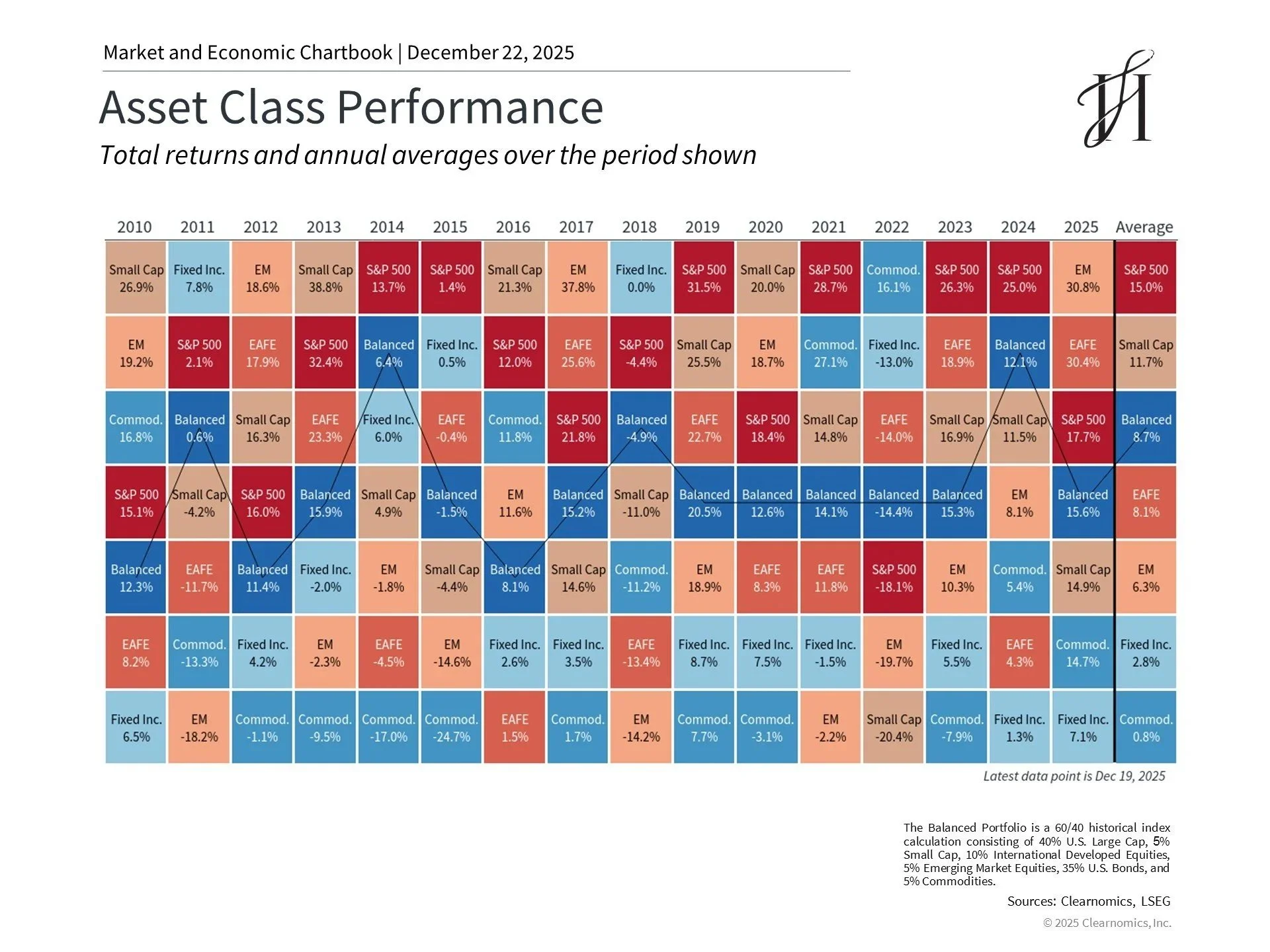
Unlike much of the past decade, returns are coming from multiple asset classes. International stocks, U.S. equities, and fixed income have all contributed, reinforcing the importance of balance rather than concentration.
In 2025, international stocks are outpacing U.S. markets, with developed market stocks (MSCI EAFE) and emerging market stocks (MSCI EM) each gaining around 30% in U.S. dollar terms. This has been driven by two key factors: improving growth expectations in many economies and the weakening dollar, which boosts returns for U.S.-based investors.
Fixed income is also playing an important stabilizing role in portfolios. The Bloomberg U.S. Aggregate Bond Index has gained 7% for the year as the Federal Reserve continues cutting interest rates and inflation stabilizes. Higher-quality bonds have been serving their purpose by providing income and offsetting stock market volatility during periods of market uncertainty.
Market valuations are approaching dot-com levels
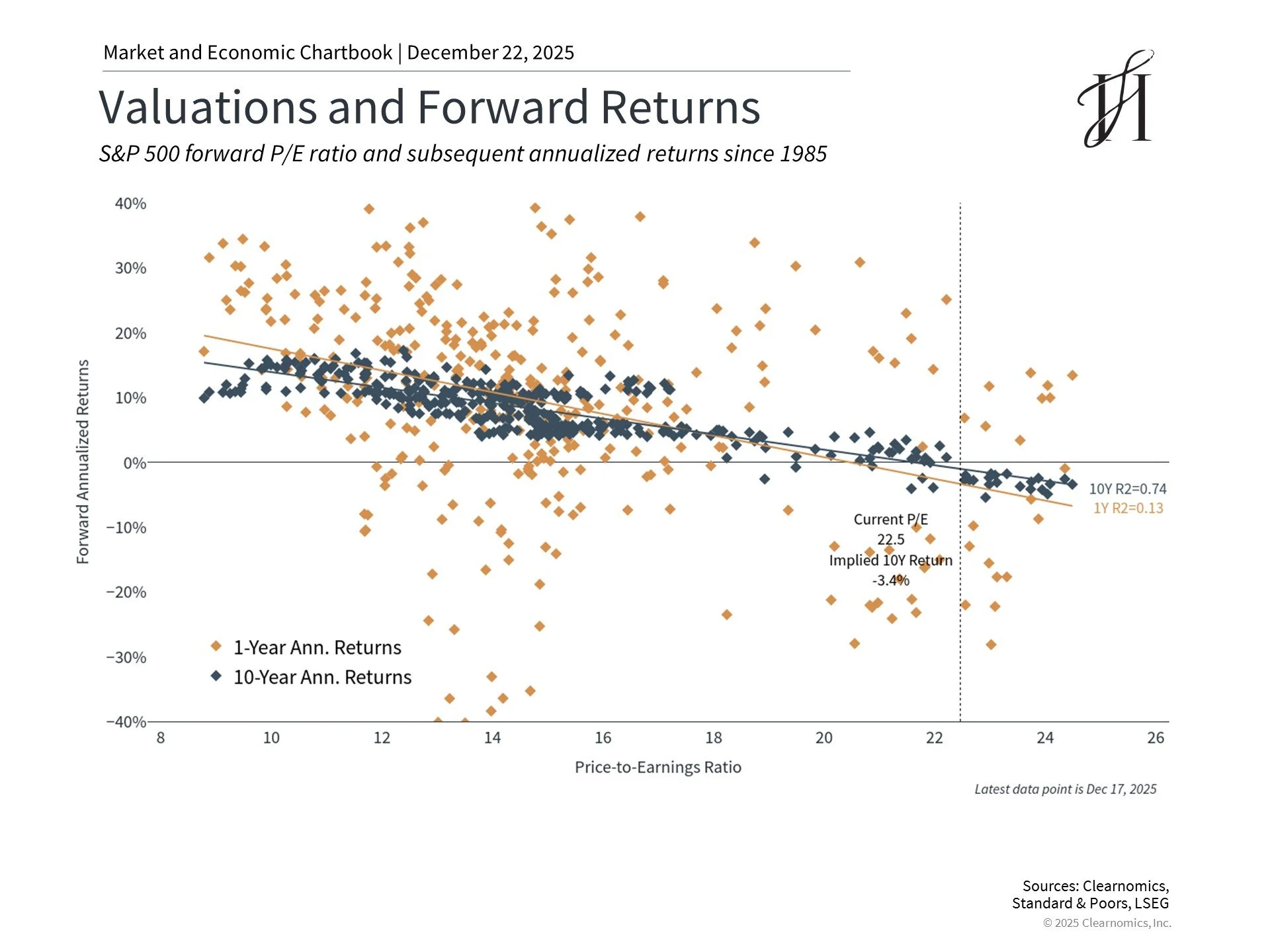
One consequence of the strong returns we’ve experienced over the past several years is that market valuations have moved higher. The S&P 500 is currently trading at roughly 22.5x forward earnings, approaching the peak levels seen during the late 1990s dot-com era.
At a basic level, higher valuations mean investors are paying more today for each dollar of expected future earnings. Naturally, this raises questions about sustainability.
Historically, valuations become concerning when they detach from underlying fundamentals. During the dot-com bubble, stock prices surged well ahead of revenues and profits, often rewarding companies simply for being adjacent to the “new economy.” Many of those businesses were unprofitable, heavily reliant on external financing, and operating with significant debt and limited cash reserves.
Today’s environment looks meaningfully different. While valuations are elevated, corporate fundamentals remain strong. Earnings growth has been healthy, balance sheets are generally robust, and many of the largest companies driving market returns are sitting on historically high levels of cash. Unlike the late 1990s, today’s market leaders are profitable, cash-flow positive, and far less dependent on debt markets to fund ongoing operations or growth initiatives.
This distinction matters. High valuations alone do not predict imminent market declines. Markets can remain expensive for extended periods, especially when earnings and cash flows continue to grow. While concerns about an “AI bubble” are understandable, not every period of enthusiasm ends in a sharp collapse. In many cases, valuations normalize gradually as fundamentals catch up, much like what we saw during the steady expansion of cloud computing over the past decade.
That said, elevated valuations do shape forward-looking expectations. When markets are already pricing in a great deal of future growth, returns tend to be more modest and volatility can increase. In environments like this, markets are often described as being “priced for perfection,” meaning even small disappointments in earnings, economic data, or policy decisions can lead to outsized reactions.
This is where portfolio construction becomes especially important. Rather than making broad directional bets, maintaining balance across asset classes, sectors, company sizes, and investment styles can help manage risk while still allowing portfolios to participate in long-term growth.
AI is driving economic growth and returns
Perhaps no theme has captured investor attention quite like AI. In 2025, spending on AI infrastructure reached historic levels, easily climbing into the trillions. That investment spans everything from massive data centers and specialized hardware like GPUs to hiring top engineering and research talent.
Some of this spending has raised eyebrows. In certain cases, the relationships feel almost circular. For example, Nvidia invested up to $100 billion in OpenAI, which in turn is buying millions of Nvidia's chips. These interconnected dynamics have led some investors to question how resilient the AI ecosystem would be if enthusiasm were to cool.
At the same time, this level of spending highlights an important reality. AI requires infrastructure so expensive and complex that very few companies can build it on their own. The real question isn’t whether AI is powerful or transformative, but whether it will ultimately generate enough economic value to justify the scale and pace of today’s investment. For now, AI spending has become a meaningful contributor to overall economic growth.
What’s happening beneath the surface is just as important. Businesses are steadily integrating AI into their operations. Surveys from the Census Bureau show that the share of companies actively using AI more than doubled between late 2023 and 2025. Adoption expectations are rising at a similar pace. While those numbers are still relatively modest, they suggest we are early in the adoption curve, not late.
For investors, AI presents both upside potential and downside risk. The Magnificent 7 technology companies continue to lead markets higher, driven by infrastructure investments and growing adoption of AI tools. However, this concentration creates vulnerability. These companies now represent about one-third of the S&P 500, meaning most investors have substantial exposure, whether they realize it or not.
The debate, then, isn’t whether AI will reshape the economy. It almost certainly will. The more nuanced question is whether current market prices reflect realistic timelines for when profits will follow. History offers perspective here. From railroads to the internet, transformative technologies tend to move through similar phases. Early skepticism gives way to rapid adoption and enthusiasm, followed by a longer period where the fundamentals gradually catch up to expectations.
The key lesson is that markets often overestimate the speed at which profits can be generated. The reality is that most investors likely have exposure to AI stocks whether directly or through major indices, so being aware of this concentration, and staying true to an appropriate asset allocation that fits with long-term goals, will be needed in the coming year.
Economic growth is slowing but remains positive
Economic growth has slowed from its post-pandemic pace, but it remains stronger than many expected. While U.S. GDP dipped slightly in the first quarter of 2025, that weakness proved short-lived. As tariff uncertainty eased, growth rebounded sharply, with the economy expanding at a 3.8% annualized rate in the second quarter. That figure not only exceeded expectations, it marked one of the strongest quarterly growth readings in years.
Globally, the picture is similar. The International Monetary Fund expects worldwide growth to ease only modestly over the next couple of years, from 3.2% in 2024 to roughly 3.1% by 2026. Advanced economies are projected to grow more slowly, around 1.5%, while emerging markets are expected to continue growing at a healthier pace above 4%.
While those numbers look solid in aggregate, they don’t tell the full story. Economic growth has been uneven across income levels and industries, often described as a “two-speed” or “K-shaped” economy. Some households and sectors are seeing real momentum, while others continue to feel financial strain.
Much of this divergence is tied to technology. Individuals and companies positioned to benefit from advances like AI tend to have stronger job prospects and earnings growth than those in more traditional industries. But technology isn’t the only factor. Higher consumer debt, rising auto loan delinquencies, and affordability pressures also shape whether households actually feel the benefits of economic growth.
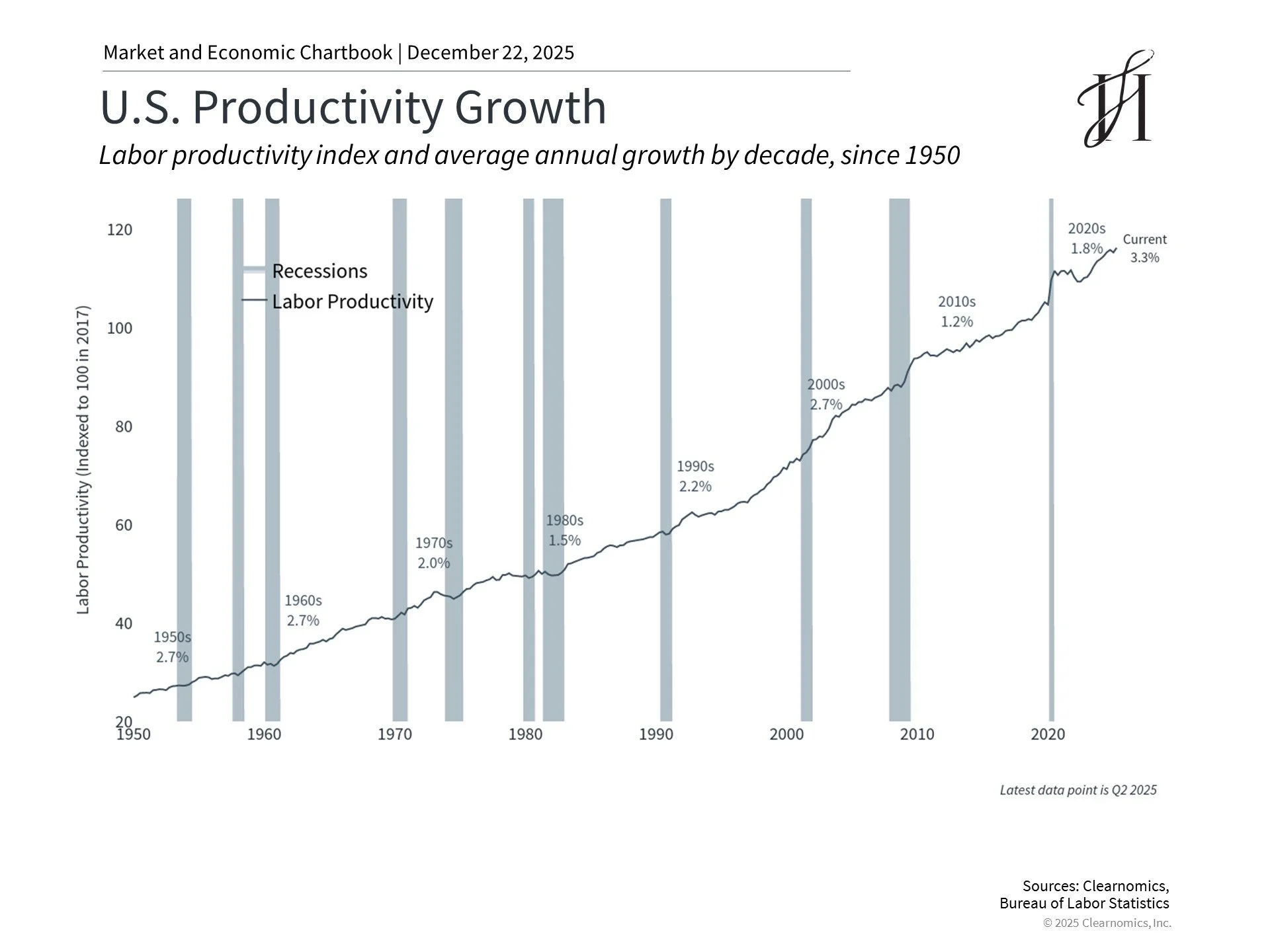
Looking further ahead, the most important question isn’t just how fast the economy grows, but how productive it becomes. Productivity reflects how much output workers can generate in a given amount of time, and historically it’s been the true engine of long-term economic growth. Better tools, better training, and smarter systems have consistently driven higher living standards over time.
Over the past decade, productivity growth averaged just 1.2% per year, which helps explain why growth often felt underwhelming despite strong markets. The promise of AI and other emerging technologies is that they could meaningfully improve productivity by helping people work more efficiently. That said, productivity gains tend to take time to materialize and are rarely distributed evenly.
For investors, rising productivity matters because it supports healthier profit margins and more sustainable economic growth over the long run. While the benefits may not show up overnight, this is one of the more constructive forces shaping the outlook for the years ahead.
The impact of tariffs remains uncertain
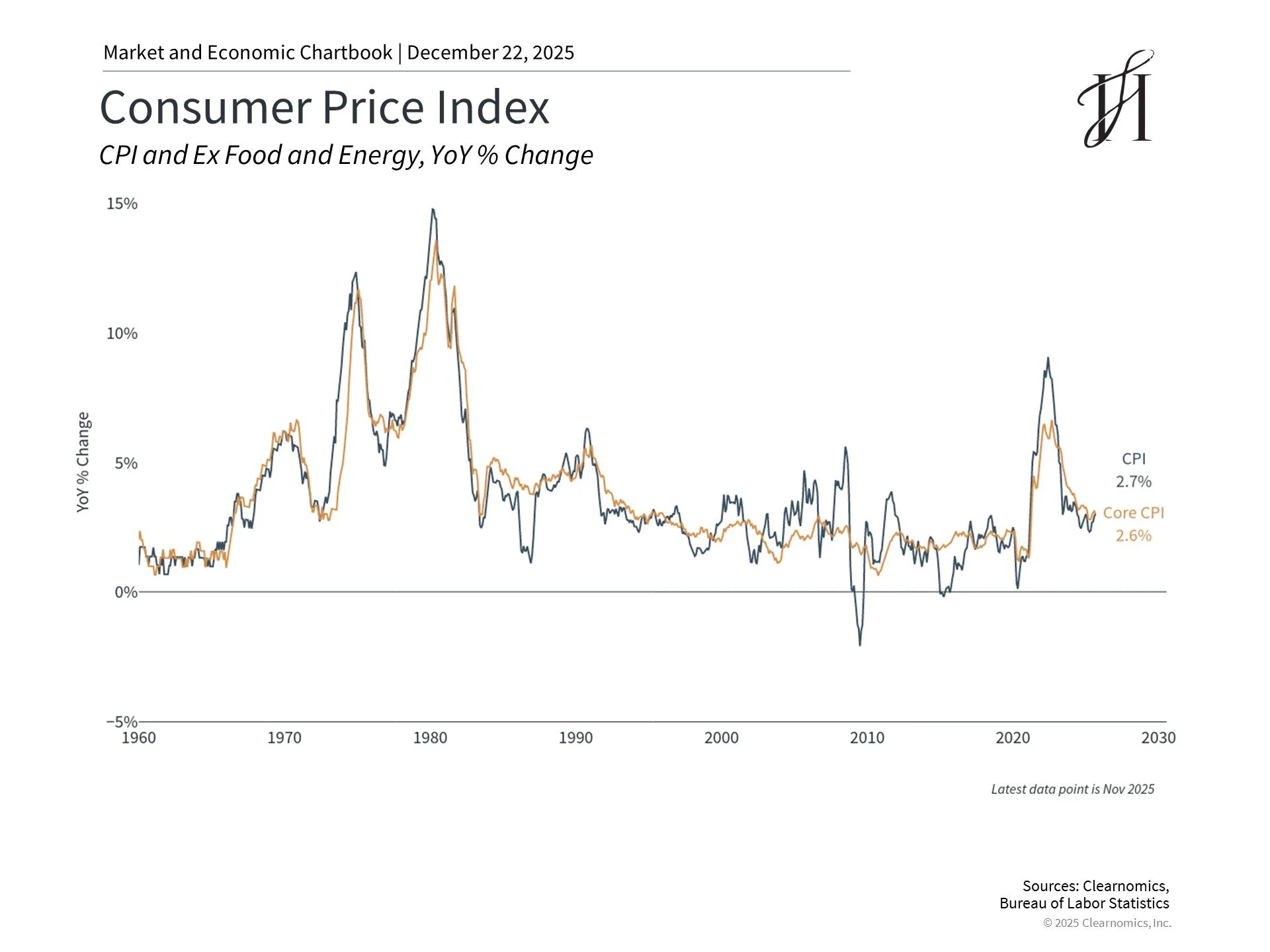
While tariffs were the primary driver of stock market volatility in 2025, their economic effects have been mixed. In fact, one of the ongoing puzzles is how little immediate impact tariffs have had on inflation and growth. Despite tariff costs increasing ten times their average level compared to prior years, measures such as the Consumer Price Index have ticked up only slightly.
There are several possible explanations as to why tariffs have not had their anticipated effect. First, many of the announced tariffs were quickly paused or scaled back. Second, many companies absorbed the initial cost of tariffs by keeping their prices steady and importing goods ahead of tariff announcements. Finally, strong consumer spending, fiscal stimulus, and healthy growth in AI-related sectors helped offset any negative impact on overall growth. It’s also worth noting that the Supreme Court may rule in 2026 on the legality of the economic justification used for these tariffs.
For long-term investors, these recent developments, along with the first round of trade negotiations in 2018, highlight the fact that tariffs are part of the government’s playbook. Rather than reacting to these tariffs as a shift in the world order, they instead represent tools for the administration to support broader policy goals. While tariffs aren’t going away, their impact on day-to-day market activity could diminish.
Midterm election and government debt will be at the forefront in 2026
In addition to changes in trade policy, 2025 also had a historic 43-day government shutdown and ongoing concerns over the size of the budget deficit. At the same time, the recently passed One Big Beautiful Bill Act (OBBBA) tax legislation has created more clarity for investors and taxpayers.
The new year will begin with more uncertainty in Washington as the short-term funding bill expires at the end of January. This means there could be another wave of negotiations that could result in another government shutdown. Then, some investors expect households and businesses to benefit from greater tax refunds due to provisions in the OBBBA such as full expensing of research and development.
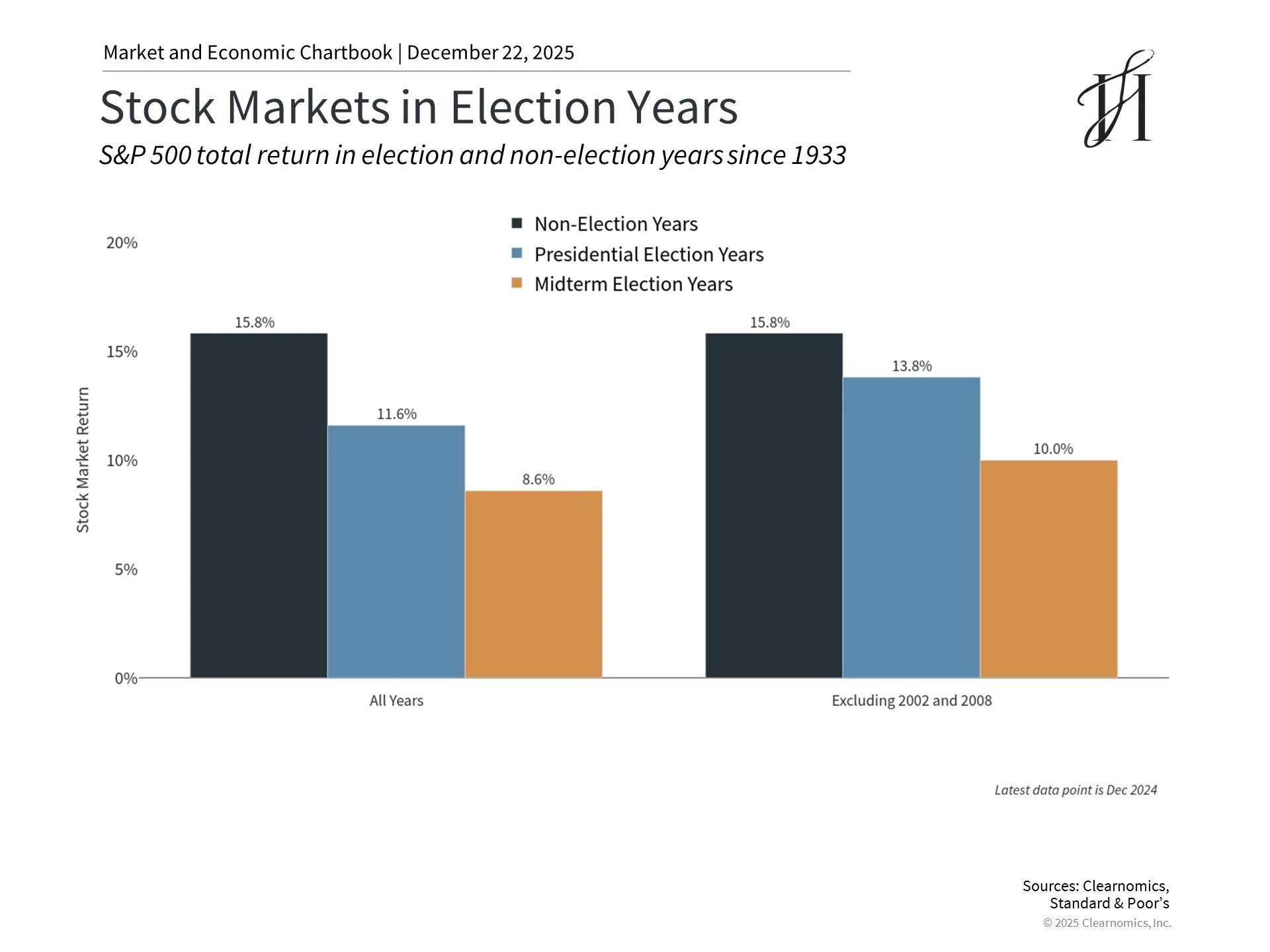
Looking further ahead, investors will likely shift their attention to the midterm election and what it could mean for tariffs, regulation, government spending, and more. The chart above shows that midterm elections have historically experienced healthy returns, averaging 8.6% since 1933, even if they are slightly lower than non-election and presidential election years.
Still, the biggest concern for many investors is the ever-growing national debt. The truth is that the historically high national debt, which is hovering around 120% of GDP for total debt, or over $36 trillion, is unlikely to be solved any time soon. In fact, it’s estimated that the OBBBA could increase the national debt by over $4 trillion in the next decade. As it stands, the national debt amounts to over $106,000 per American.
For long-term investors, it’s important to recognize what we can and cannot control. For example, the national debt has been a challenge for decades, yet investing based on these concerns would have resulted in the wrong portfolio positioning. While the sustainability of the U.S. federal debt may have implications for economic growth and interest rates, history shows that this should not be the primary driver of portfolios.
Instead, what we can control in the short run is understanding the key changes to tax legislation and how it impacts long-term planning. These include the fact that lower tax rates from the Tax Cuts and Jobs Act are now permanent, estate tax exemption levels will remain higher, SALT deduction caps have risen, and many other provisions. It’s the perfect time to review your tax strategies to ensure you take full advantage of these new rules.
The Federal Reserve’s Role Is Evolving
The Fed resumed cutting rates in September after pausing earlier in the year. As we enter 2026, the path of monetary policy could become less certain. This is because the risk of runaway inflation may no longer be the primary concern as a weaker job market has grown in importance. This requires tweaks to policy rates rather than dramatic shifts, such as those seen in 2022.
An additional complication is that Fed Chair Jerome Powell's term will end on May 15, 2026, paving the way for new leadership at the Fed. The White House is expected to appoint a successor who may favor additional rate cuts to support the administration's economic agenda of lower interest rates.
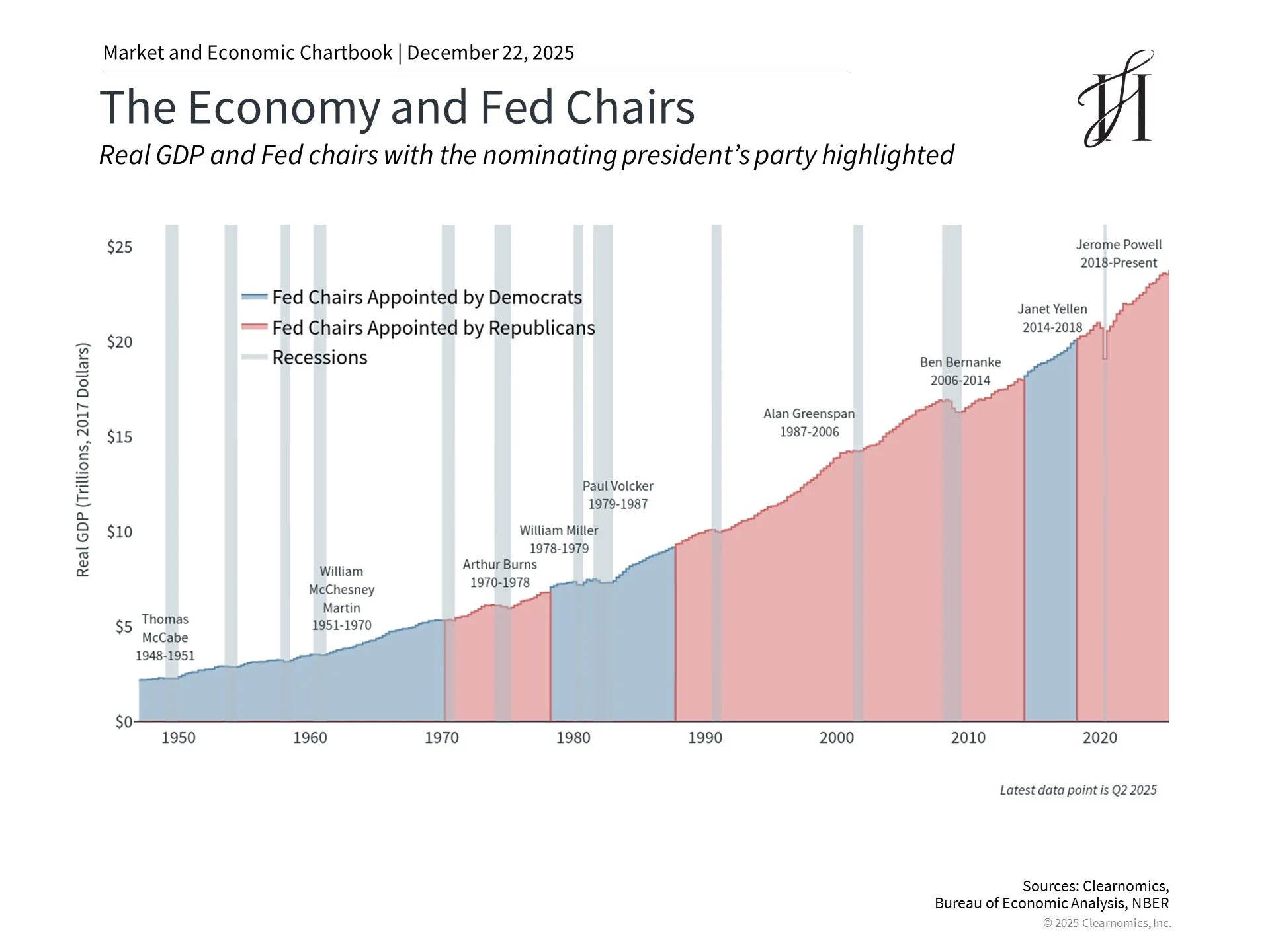
The chart above shows that the economy has performed well across Fed Chairs appointed by both parties. It’s important to note that the Fed only controls the “short end” of the yield curve, that is, interest rates that are closely tied to the federal funds rate. Long-term interest rates depend on many other factors, such as economic growth, inflation, and productivity. So, rather than follow the Fed’s every move and parse every statement, investors should continue to focus on these longer-term trends to understand the impact on interest rates and bonds.
Maintaining perspective in 2026
As we enter 2026, the list of concerns is long, as it always is. Yet markets have consistently rewarded patient, disciplined investors over time.
The bottom line is this: strong returns have lifted portfolios, but elevated valuations and slowing global growth suggest more moderate expectations going forward. Rather than attempting to time the market or react to any single narrative, the focus remains on building portfolios designed for resilience.
That’s the work we’re doing every day behind the scenes.
Want the Full Research?
This blog reflects many of the themes outlined in LPL Research’s 2026 Market Outlook: The Policy Engine. If you’d like to explore their full analysis, charts, and detailed commentary, you can download the complete report below.
As always, if you’d like to talk through how these themes apply specifically to your plan, I’m here.
Securities and advisory services offered through LPL Financial, a Registered Investment Advisor, Member FINRA/SIPC.
Copyright (c) 2025 Clearnomics, Inc. All rights reserved. The information contained herein has been obtained from sources believed to be reliable, but is not necessarily complete and its accuracy cannot be guaranteed. No representation or warranty, express or implied, is made as to the fairness, accuracy, completeness, or correctness of the information and opinions contained herein. The views and the other information provided are subject to change without notice. All reports posted on or via www.clearnomics.com or any affiliated websites, applications, or services are issued without regard to the specific investment objectives, financial situation, or particular needs of any specific recipient and are not to be construed as a solicitation or an offer to buy or sell any securities or related financial instruments. Past performance is not necessarily a guide to future results. Company fundamentals and earnings may be mentioned occasionally, but should not be construed as a recommendation to buy, sell, or hold the company's stock. Predictions, forecasts, and estimates for any and all markets should not be construed as recommendations to buy, sell, or hold any security--including mutual funds, futures contracts, and exchange traded funds, or any similar instruments. The text, images, and other materials contained or displayed in this report are proprietary to Clearnomics, Inc. and constitute valuable intellectual property. All unauthorized reproduction or other use of material from Clearnomics, Inc. shall be deemed willful infringement(s) of this copyright and other proprietary and intellectual property rights, including but not limited to, rights of privacy. Clearnomics, Inc. expressly reserves all rights in connection with its intellectual property, including without limitation the right to block the transfer of its products and services and/or to track usage thereof, through electronic tracking technology, and all other lawful means, now known or hereafter devised. Clearnomics, Inc. reserves the right, without further notice, to pursue to the fullest extent allowed by the law any and all criminal and civil remedies for the violation of its rights.