
July Market Recap
If there was one lesson July reinforced, it's that even strong markets experience periods of uncertainty.
After months of steady gains, investors were reminded that volatility is a normal part of investing. Questions surrounding artificial intelligence spending, rising Treasury yields, renewed tensions in the Middle East, and uncertainty around future Federal Reserve policy all contributed to a month that felt more unsettled than those preceding it.
Yet when we zoom out, the bigger picture remains much the same.
Markets finished July only modestly lower despite several significant headlines. The S&P 500 was nearly unchanged for the month, the Dow Jones Industrial Average posted a small gain, and while technology stocks experienced greater volatility, the broader market remains near all-time highs after a strong year-to-date run.
For investors, this serves as an important reminder.
Strong markets don't move in a straight line. Even during healthy bull markets, periods of uncertainty, pullbacks, and shifting leadership are completely normal. The challenge isn't avoiding volatility—it's maintaining perspective while it's happening.
AI Continues to Shape Markets
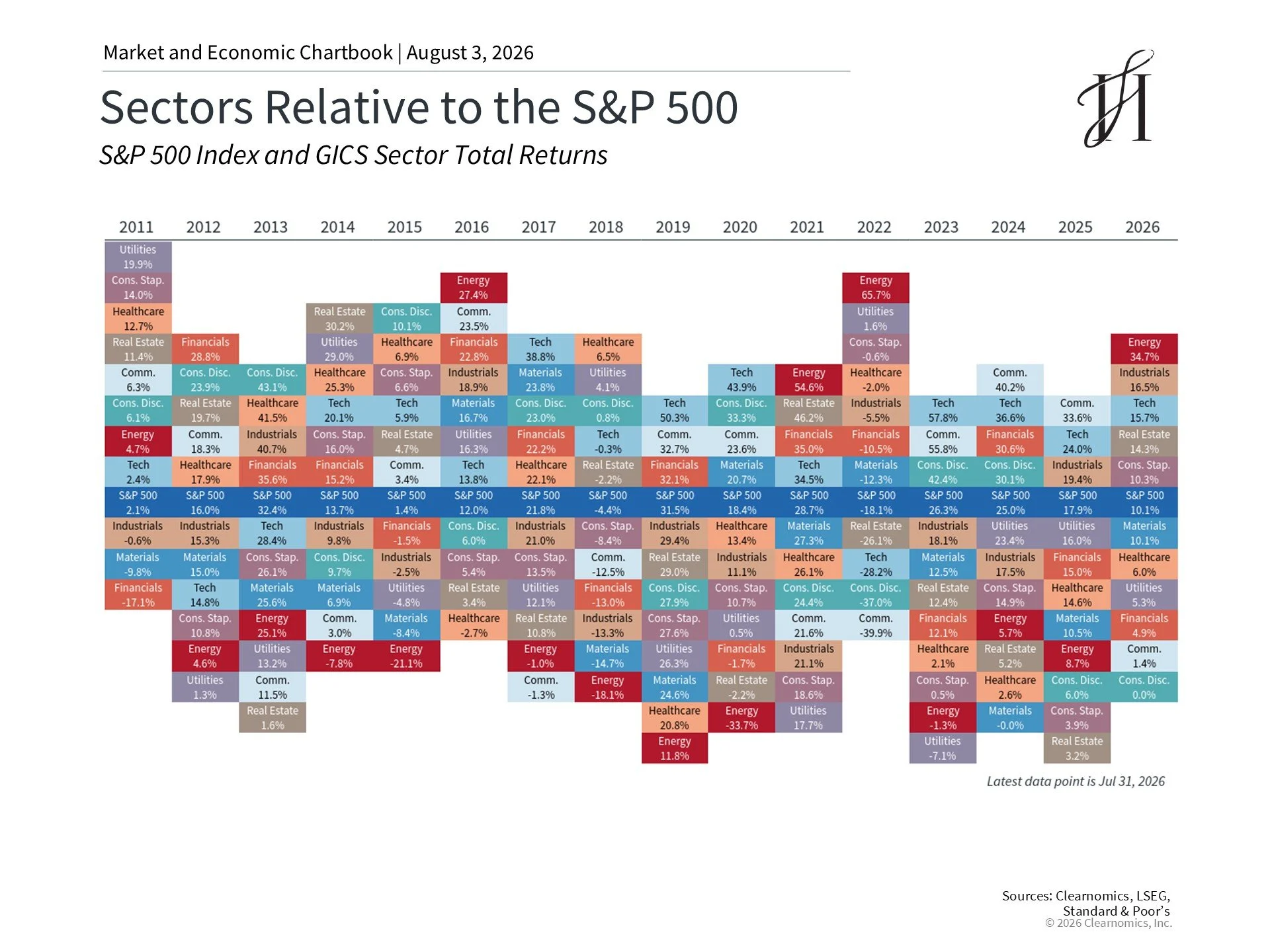
Artificial intelligence remained one of the biggest drivers of market activity in July, though the story became more nuanced.
Over the past year, many of the largest technology companies have invested hundreds of billions of dollars into data centers, chips, and AI infrastructure. While investors remain optimistic about the long-term potential of artificial intelligence, July raised an important question:
When will those investments begin generating meaningful returns?
Several large technology companies reported earnings that prompted investors to examine whether current spending levels are sustainable. At the same time, global semiconductor companies also experienced increased volatility, illustrating that even some of the market's strongest-performing sectors can experience periods of reassessment.
None of this necessarily changes the long-term outlook for AI.
Innovation rarely follows a perfectly smooth path. New technologies often experience periods of excitement followed by periods where investors evaluate whether expectations have become too optimistic. That's simply part of how markets price future growth.
For diversified investors, it's another reminder that no single sector should determine the success of an overall financial plan.
Rising Yields Continue to Matter
Another important story this month unfolded in the bond market.
Treasury yields climbed to some of their highest levels in nearly two decades, with the 30-year Treasury reaching approximately 5.3% and the 10-year Treasury nearing 4.7%. As yields moved higher, bond prices declined modestly, contributing to additional market volatility.
Why does this matter?
Interest rates influence nearly every part of the economy.
Higher borrowing costs affect mortgages, business financing, auto loans, and consumer spending. They also impact how investors value stocks and other financial assets.
At the same time, higher yields create opportunities that haven't existed for many years.
After spending much of the last decade in a low-interest-rate environment, investors can once again earn meaningful income from high-quality bonds. While rising yields can create short-term fluctuations in bond prices, they also improve the long-term income potential for diversified portfolios.
As is often true in investing, every challenge can also create new opportunities.
The Federal Reserve Takes a Measured Approach
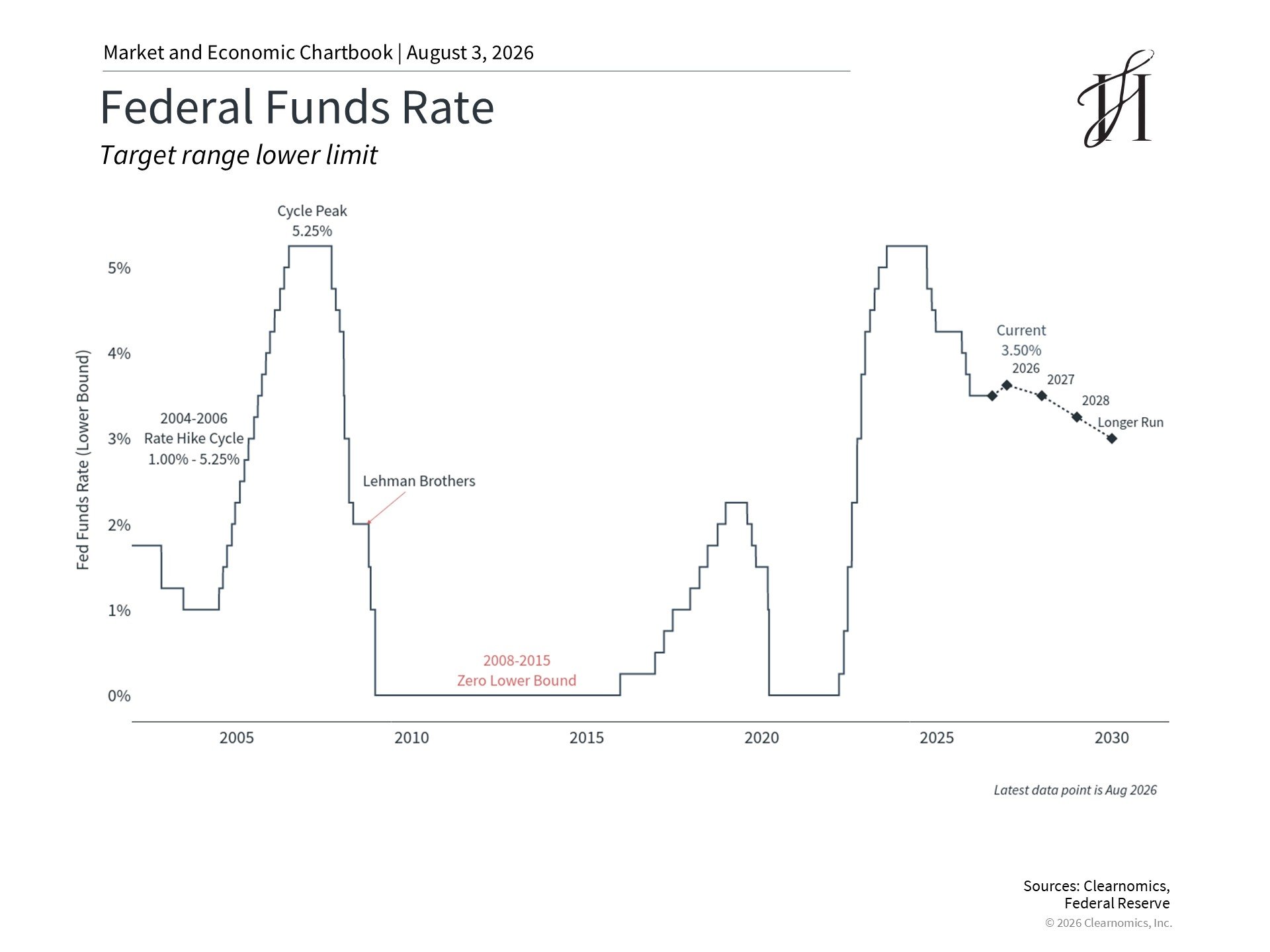
The Federal Reserve also remained in focus throughout July.
At its July meeting, policymakers chose to leave interest rates unchanged, but investors paid close attention to what wasn't said as much as what was. New Fed Chair Kevin Warsh has adopted a more measured communication style, offering less guidance about future policy decisions than markets have become accustomed to.
That uncertainty contributed to higher Treasury yields and increased day-to-day market swings.
It's natural for investors to wonder what the Federal Reserve will do next, but history reminds us that markets have successfully navigated many different interest rate environments, economic cycles, and Fed leadership transitions over time.
Long-term investment success has never depended on predicting the next Fed meeting.
Geopolitical Headlines Return
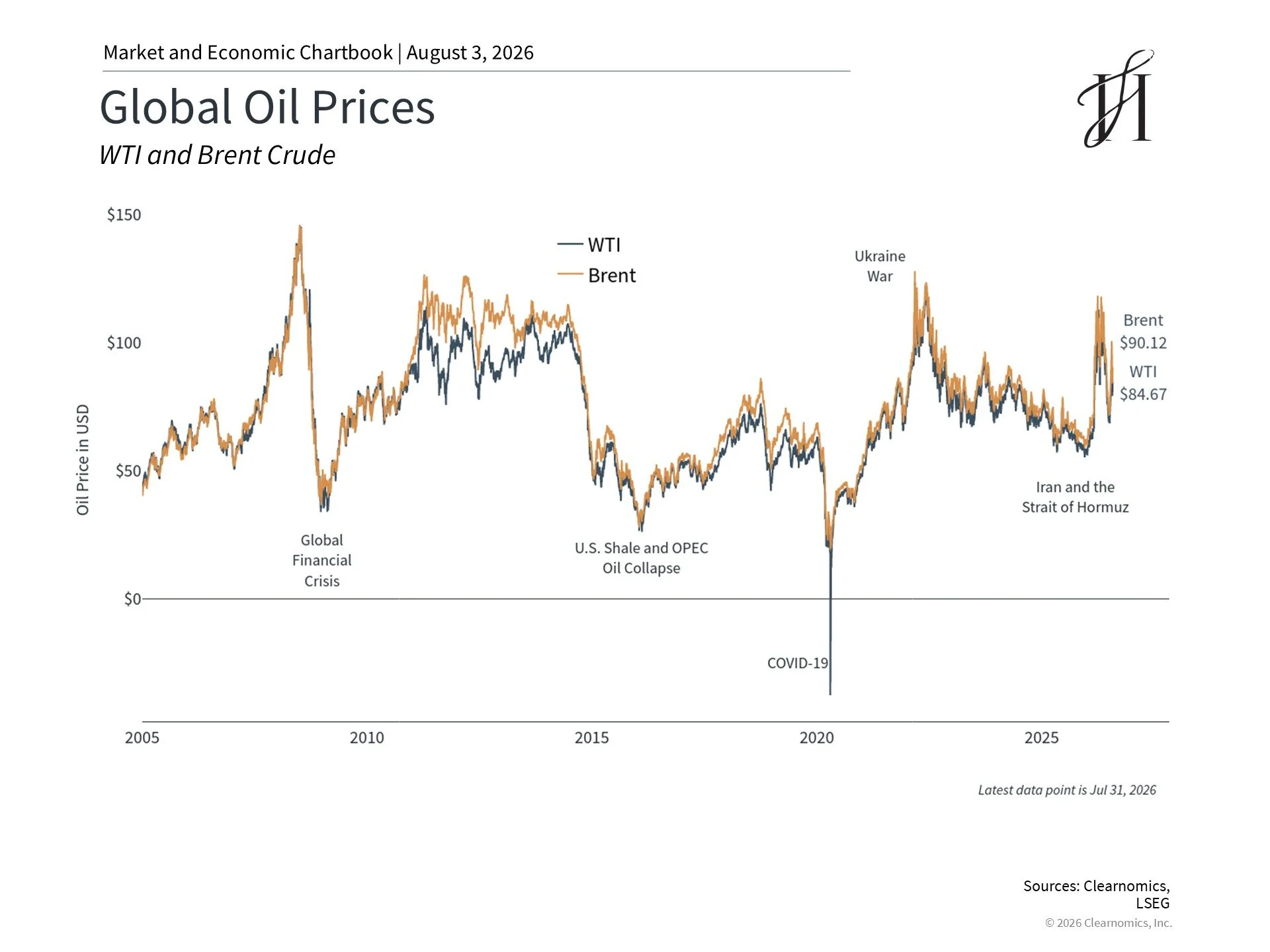
July also saw renewed geopolitical tensions in the Middle East, temporarily pushing oil prices above $100 per barrel before they settled back lower by month-end. Concerns centered around disruptions to important global shipping routes, which raised fears of higher energy costs and renewed inflationary pressure.
Markets often react quickly to geopolitical events because they create uncertainty around global trade, inflation, and economic growth.
However, history has also shown that while these events can create short-term volatility, markets have repeatedly adapted as new information becomes available.
This is another example of why reacting emotionally to headlines can be more damaging than the headlines themselves.
Looking Beyond the Headlines
If there was a common theme throughout July, it was uncertainty.
Questions surrounding artificial intelligence. Higher interest rates. Geopolitical conflict. Tariff developments. Federal Reserve policy. Any one of these topics could dominate the daily news cycle. Together, they created an environment where volatility felt unavoidable.
But uncertainty has always been part of investing.
Every year brings new headlines that feel significant in the moment. Some ultimately reshape the economy. Others fade into the background. The challenge is that it's nearly impossible to know which is which while we're living through them.
That's why successful investing has never been about predicting every market move.
It's about building a thoughtful financial plan, maintaining a diversified portfolio, and staying focused on long-term goals rather than short-term headlines.
At Infinite Heights, we believe financial planning is about creating confidence through every market environment—not just the easy ones. Markets will continue to experience periods of volatility, economic conditions will evolve, and headlines will always compete for our attention.
Your financial plan, however, should remain centered on something far more important: the life you're building and the goals you're working toward.
If you have questions about how recent market activity relates to your financial plan, we're always happy to have that conversation.
Securities and advisory services offered through LPL Financial, a Registered Investment Advisor, Member FINRA/SIPC.
Copyright (c) 2026 Clearnomics, Inc. All rights reserved. The information contained herein has been obtained from sources believed to be reliable, but is not necessarily complete and its accuracy cannot be guaranteed. No representation or warranty, express or implied, is made as to the fairness, accuracy, completeness, or correctness of the information and opinions contained herein. The views and the other information provided are subject to change without notice. All reports posted on or via www.clearnomics.com or any affiliated websites, applications, or services are issued without regard to the specific investment objectives, financial situation, or particular needs of any specific recipient and are not to be construed as a solicitation or an offer to buy or sell any securities or related financial instruments. Past performance is not necessarily a guide to future results. Company fundamentals and earnings may be mentioned occasionally, but should not be construed as a recommendation to buy, sell, or hold the company's stock. Predictions, forecasts, and estimates for any and all markets should not be construed as recommendations to buy, sell, or hold any security--including mutual funds, futures contracts, and exchange traded funds, or any similar instruments. The text, images, and other materials contained or displayed in this report are proprietary to Clearnomics, Inc. and constitute valuable intellectual property. All unauthorized reproduction or other use of material from Clearnomics, Inc. shall be deemed willful infringement(s) of this copyright and other proprietary and intellectual property rights, including but not limited to, rights of privacy. Clearnomics, Inc. expressly reserves all rights in connection with its intellectual property, including without limitation the right to block the transfer of its products and services and/or to track usage thereof, through electronic tracking technology, and all other lawful means, now known or hereafter devised. Clearnomics, Inc. reserves the right, without further notice, to pursue to the fullest extent allowed by the law any and all criminal and civil remedies for the violation of its rights.